
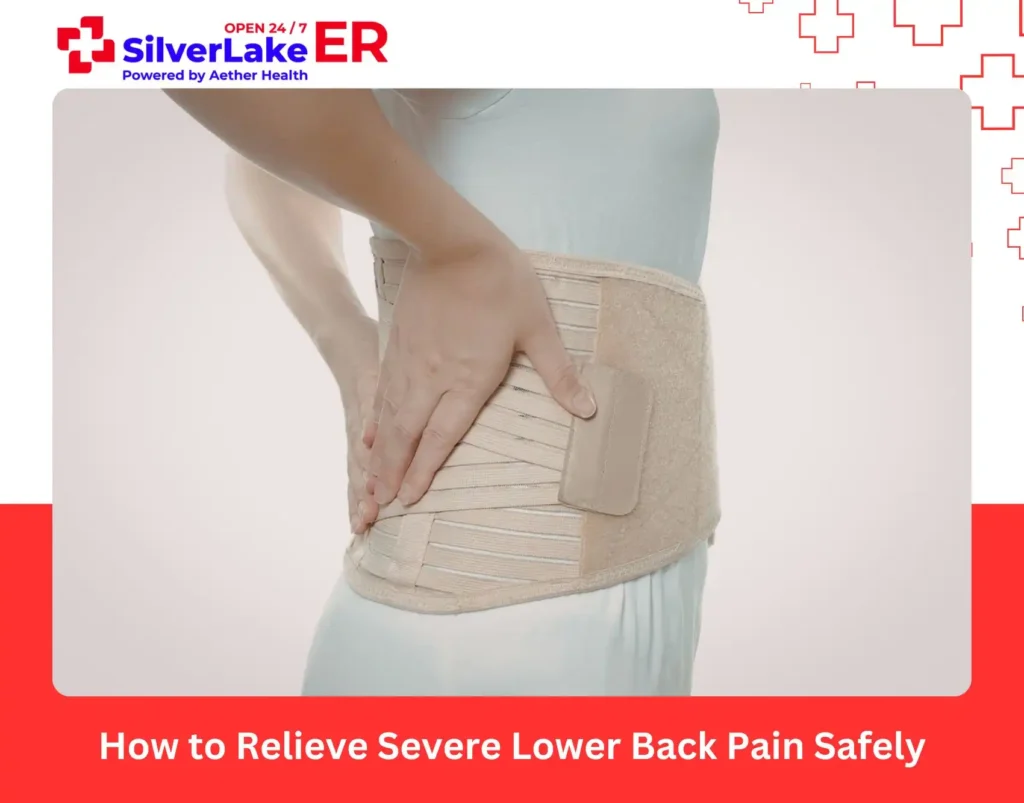
Severe lower back pain has a way of stopping everything. You can’t work, you can’t sleep well, you can’t even sit comfortably. The instinct is to search for anything that will make it stop right now.
Most severe lower back pain does improve with the right self-care over one to two weeks. Some of it does not, and knowing the difference matters. This guide answers the questions you’re likely asking at each stage: right now, in a few days, and if the pain isn’t easing. If any red-flag signs appear along the way, Aether Health – Silverlake ER is open 24/7 for evaluation.
The Short Answer
To relieve severe lower back pain safely, apply cold to the area for 15-20 minutes at a time during the first 48 hours, avoid bed rest beyond a day or two, keep gentle movement going, use over-the-counter pain relief as directed on the label, and sleep in positions that keep your spine neutral. After 48 hours, switch to heat. See a doctor if pain doesn’t improve within two weeks or if red-flag symptoms like numbness, weakness, bladder changes, or fever appear at any point.
It Hurts Right Now. What Should I Do in the First 48 Hours?

Your goal in the first two days is to calm the acute inflammation without making things worse by lying still for too long. This is a balance, not an on-off switch.
Apply cold to the affected area for 15-20 minutes at a time, several times a day. Use an ice pack wrapped in a thin towel to protect your skin. Cold reduces the initial inflammation and dulls the pain signal. Skip the heat for now, because heat can increase inflammation during the first 48 hours.
Rest, but not for long. Lying completely still for more than a day or two actually slows recovery and stiffens the muscles further. Rest for a few hours at a time in a comfortable position, then get up and move gently around the house. Even short walks help.
Over-the-counter pain relievers can help take the edge off. Follow the label directions and check with your pharmacist or physician if you have any medical conditions or take other medications. As the National Center for Complementary and Integrative Health notes, non-drug approaches often work better when combined with a short course of over-the-counter pain relief rather than either alone.
Sleep in a position that keeps your spine neutral. If you sleep on your side, put a pillow between your knees. If you sleep on your back, put a pillow under your knees. Avoid sleeping on your stomach, which twists the lower back into an unhelpful position.¹
It’s Been a Few Days. What Do I Do Now?
By day 3 or 4, the acute inflammation is usually calming down, and your focus shifts from calming the pain to gently restoring movement. This is when many people slow their recovery by resting too long.
Switch from cold to heat. A heating pad or warm bath for 15-20 minutes at a time relaxes tight muscles, improves blood flow, and eases the ongoing ache. Some people alternate between heat and cold. Whatever feels better to you is fine.
Start moving more. Gentle walking is one of the most effective things you can do for severe lower back pain. The Centers for Disease Control and Prevention emphasizes that regular movement supports recovery from most musculoskeletal pain. Start with short walks around your home or block. Add distance as tolerated. Avoid running, heavy lifting, or twisting motions.²
Pay attention to what makes it worse. If sitting for long stretches, specific movements, or certain positions clearly aggravate the pain, avoid those. Adjust your work setup, take standing breaks, and listen to your body’s signals.
It’s Been Two Weeks and It Isn’t Better. What Now?

If severe lower back pain hasn’t meaningfully improved after two weeks of consistent self-care, it’s time for a professional evaluation. This doesn’t mean anything is seriously wrong, but it does mean home care alone probably isn’t the right approach for your specific situation.
Contact a doctor sooner than two weeks if any of these apply.
- The pain is getting worse instead of better.
- Pain is spreading down one or both legs.
- You’re developing numbness, tingling, or weakness in your legs.
- Standing for even short periods has become impossible.
- Sleep is significantly disrupted despite trying different positions.
- Over-the-counter pain relief isn’t helping at all.
Warning Signs That Mean Skip Home Care and Go to the ER

Certain signs mean severe lower back pain isn’t a self-care situation. It’s an emergency. If you notice any of the following, go directly to an ER instead of waiting.
- Loss of bladder or bowel control, or new inability to urinate.
- Numbness in the groin, inner thighs, or saddle area.
- Sudden weakness in one or both legs.
- Severe back pain that started after a fall, car accident, or major impact.
- Back pain accompanied by fever, chills, or unexplained weight loss.
- Pain so severe it prevents you from moving at all, or wakes you from sleep every night.
For severe back pain following any trauma, prompt emergency care for suspected fractures with on-site imaging can rule out spinal fractures or dangerous soft tissue injuries. Waiting delays diagnosis and can make outcomes worse.
Common Mistakes That Prolong Severe Back Pain
These are the four mistakes most people make that keep severe back pain going longer than it needs to.
- Staying in bed for days at a time. Prolonged bed rest weakens muscles and stiffens joints.
- Using heat too early. Heat during the first 48 hours can increase inflammation. Wait until the acute phase passes.
- Returning to normal activity too fast once pain eases. This is when most people re-injure themselves.
- Ignoring red-flag symptoms because the pain “probably isn’t that bad.” Numbness, weakness, or bladder changes are never just muscle strain.
Frequently Asked Questions
How long does severe lower back pain usually last?
Most severe lower back pain from muscle strain improves significantly within one to two weeks and resolves fully within four to six weeks. If pain persists beyond two weeks or worsens, see a doctor for evaluation.
Is it safe to exercise with severe lower back pain?
Gentle walking is generally safe and helpful. Heavy lifting, running, twisting, and high-impact activities should wait until pain has substantially improved. If any movement causes sharp shooting pain down your leg, stop that activity.
What’s the best sleeping position for severe lower back pain?
Side sleeping with a pillow between your knees, or back sleeping with a pillow under your knees. Both positions keep the spine neutral. Avoid sleeping on your stomach, which twists the lower back.
Should I get an X-ray or MRI for severe lower back pain?
Not usually in the first few weeks unless you have red-flag symptoms or the pain followed a fall or accident. Imaging is generally recommended when pain persists beyond four to six weeks or when neurological symptoms are present.
Can severe lower back pain go away on its own?
Often, yes. The majority of severe lower back pain resolves with self-care within a few weeks. However, some causes need professional evaluation, especially if red-flag symptoms appear or if pain persists longer than two weeks.
Severe Back Pain That Isn’t Improving Near Pearland?
When severe lower back pain doesn’t respond to safe self-care, or when red-flag signs appear, professional evaluation matters. Our back injury emergency evaluation team provides on-site imaging, lab work, and same-day assessment 24/7 at 2752 Sunrise Blvd, Pearland, TX 77584. Call +1 (713) 528-8703 or walk in anytime.
Call 911 immediately for severe lower back pain with loss of bladder or bowel control, sudden leg weakness, numbness in the groin or saddle area, or severe pain following major trauma. These signs can indicate serious conditions requiring emergency intervention within hours.
External References Links :
1.National Center for Complementary and Integrative Health
2.Centers for Disease Control and Prevention