
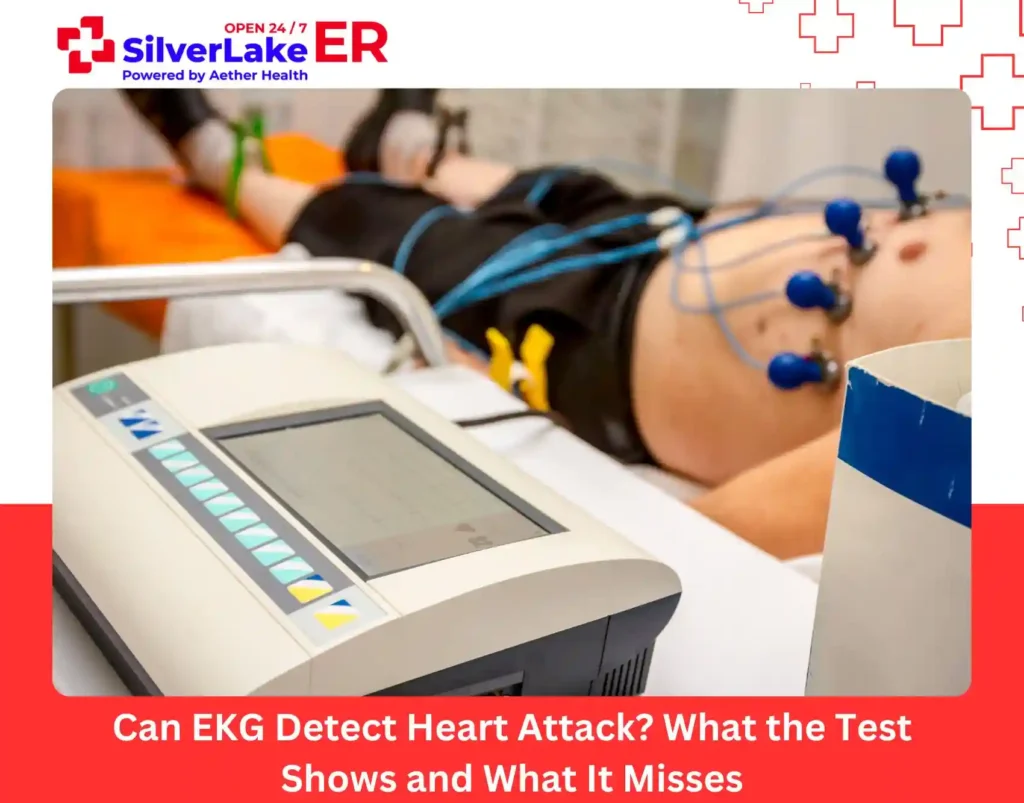
Few medical tests feel as urgent as the one minute an EKG tracing takes while a nurse watches your face. Those twelve wavy lines on the screen hold a tremendous amount of information about your heart, and in many cases, they confirm or rule out a heart attack within seconds. However, the full picture is a little more nuanced than that simple yes-or-no that most patients expect.
This guide answers exactly what an EKG can and cannot show about a heart attack, what the common patterns mean, which other tests doctors use alongside it, and when you should treat chest symptoms as a 911 situation. Modern cardiac emergency protocols rely on fast EKG reading combined with blood tests and imaging, and understanding how each piece fits helps you make better decisions when every minute counts.
| Quick Answer
Yes, an EKG can detect many heart attacks, but not all of them. A standard 12-lead EKG picks up STEMI heart attacks almost immediately by showing ST segment elevation. However, non-STEMI, silent, and early-presenting heart attacks can produce normal or near-normal EKG readings. For a complete answer, doctors combine EKG results with blood tests (troponin), imaging, and clinical evaluation. |
How an EKG Works in Simple Terms
An EKG (electrocardiogram, sometimes written ECG) measures the electrical activity of your heart. Twelve sticky electrodes placed on your chest, arms, and legs pick up the tiny electrical signals your heart muscle produces with every beat. The machine translates those signals into waves on a strip of paper or a screen. According to the American Heart Association, EKG readings help doctors identify specific patterns that correspond to common cardiac events, including heart attacks caused by blocked arteries.¹
The whole test takes about five to ten minutes and causes no pain. Readings are available within seconds. In an emergency setting, a physician can glance at the strip and recognize a classic heart attack pattern almost immediately. At Silverlake ER, we also run cardiac blood tests on-site alongside the EKG, so the full diagnostic picture comes together without delay.
An EKG strip prints within seconds. For a classic STEMI pattern, a trained physician can recognize a heart attack in under a minute.
IN SHORT: An EKG reads your heart’s electrical activity in minutes and often catches a heart attack on the first strip, but doctors still pair it with blood tests to confirm.
What an EKG Can Detect
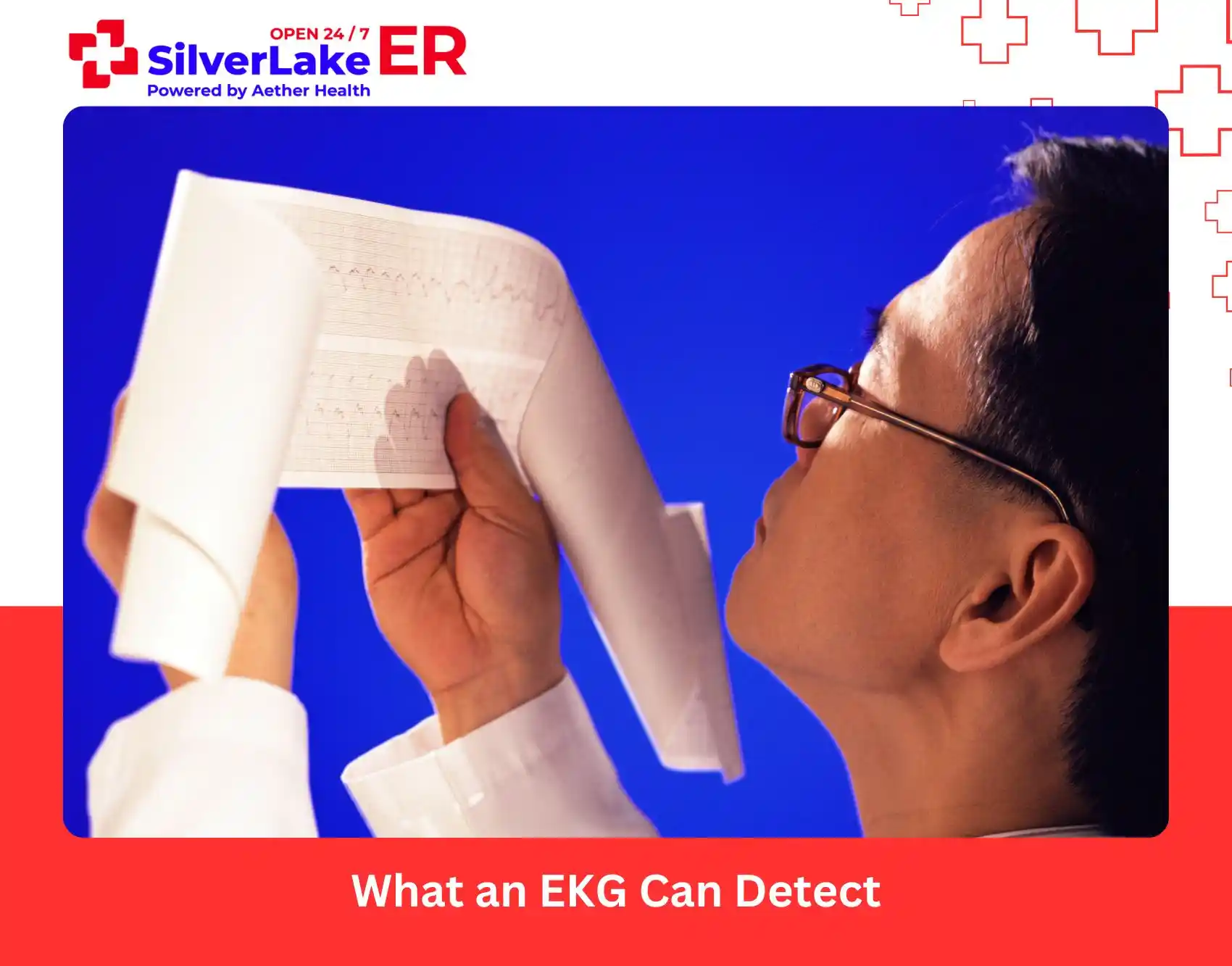
A standard 12-lead EKG captures several heart attack signatures and other cardiac issues. Doctors look for these specific findings on the tracing.
#1 ST segment elevation. Signals a STEMI (ST elevation myocardial infarction) and typically means a major coronary artery is completely blocked. This is the fastest-recognized heart attack pattern.
#2 ST depression or T wave inversion. Can suggest NSTEMI (non-ST elevation myocardial infarction) or ongoing cardiac ischemia. Often requires repeat EKGs plus blood tests to confirm.
#3 Pathologic Q waves. Indicate heart muscle damage from either a prior or current heart attack. Useful for identifying silent attacks that happened days or weeks ago.
#4 Abnormal heart rhythms. Arrhythmias such as ventricular tachycardia often accompany or follow a heart attack. The EKG picks these up on the first tracing.
#5 Chamber strain or heart block. Signs of enlargement, strain on specific chambers, or electrical conduction blocks. These findings guide broader cardiac evaluation.
What EKG Findings Mean: Quick Reference
This reference connects common EKG findings to what they likely mean and what doctors typically do next. It is not a substitute for medical interpretation but helps you understand what the test is actually showing.
| EKG Finding | What It Means | Next Step |
| ST elevation (STEMI) | Full artery blockage, active heart attack | Immediate cardiac catheterization |
| ST depression / T inversion | Possible NSTEMI or ischemia | Blood tests, repeat EKG, imaging |
| New Q waves | Heart muscle damage, prior or current attack | Confirm with blood tests, imaging |
| Abnormal rhythm | Arrhythmia from various causes | Rhythm monitoring, cardiac workup |
| Normal EKG | No clear electrical signs of attack | May still need blood tests and observation |
The Important “But”: When an EKG Can Miss a Heart Attack
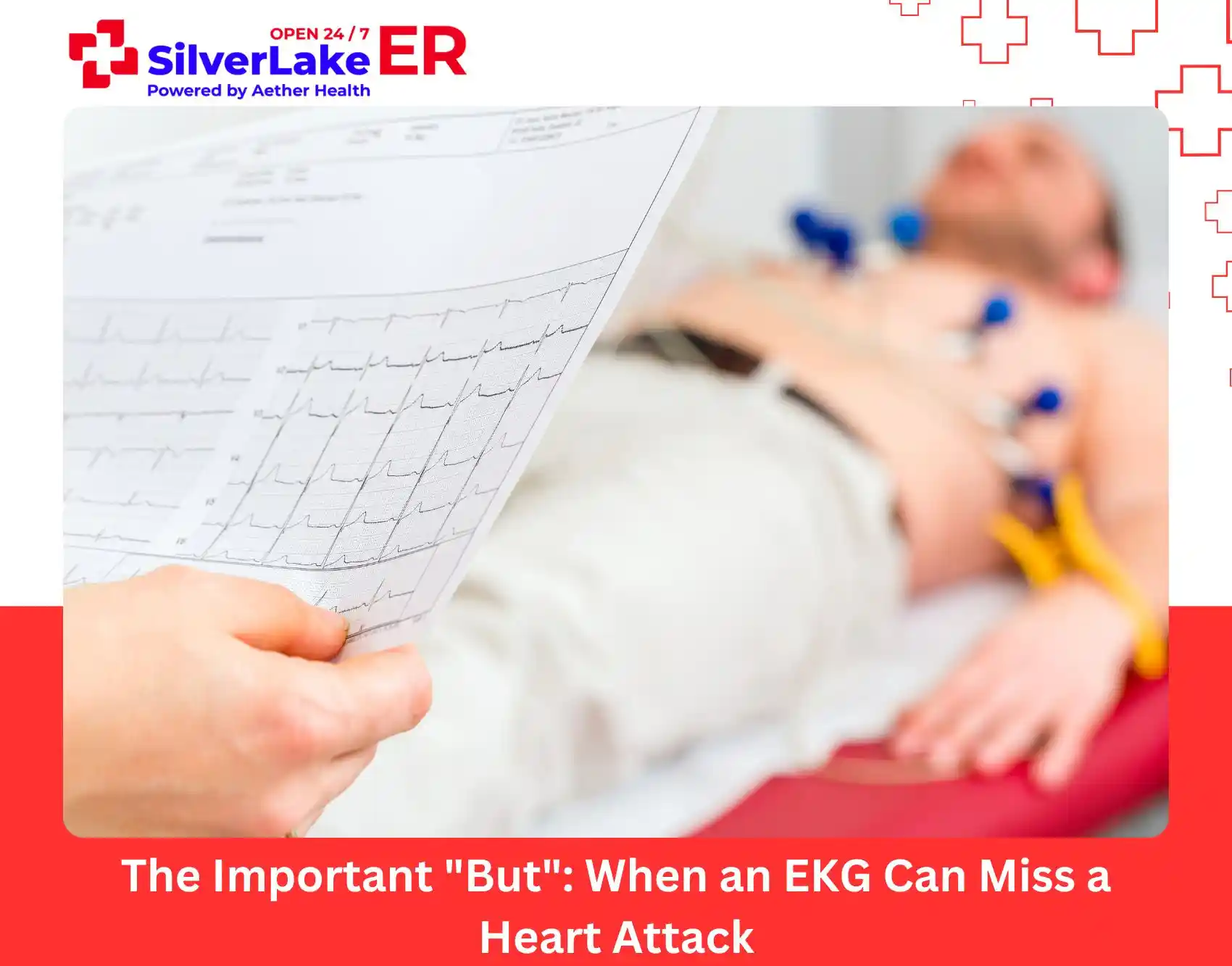
A single EKG does not catch every heart attack. Several situations can produce a normal or near-normal tracing even when heart muscle is being damaged in real time.
Early presentation
If you arrive at the ER within the first hour of symptoms, EKG changes may not have fully developed yet. A repeat EKG an hour later often reveals patterns the first one missed. This is why observation and repeat testing matter.
Silent heart attacks
These go undetected on EKG more often than people realize, particularly in women, older adults, and people with diabetes. The symptoms may be subtle or absent entirely, and EKG changes are often minimal.
Posterior wall and right ventricular attacks
Some anatomical locations hide poorly from a standard 12-lead reading. These attacks produce changes that need extra lead placements or complementary tests to catch. The heart attack team at Silverlake ER combines EKG, troponin blood tests, and imaging in one visit to catch what any single test might miss.
Studies show a single EKG misses roughly 35 to 45 percent of heart attacks on the first reading. Troponin and repeat EKGs close that gap.
IN SHORT: A normal EKG does not rule out a heart attack. Early, silent, and posterior attacks need blood tests, imaging, or repeat EKGs to catch.
Other Tests Used Alongside EKG
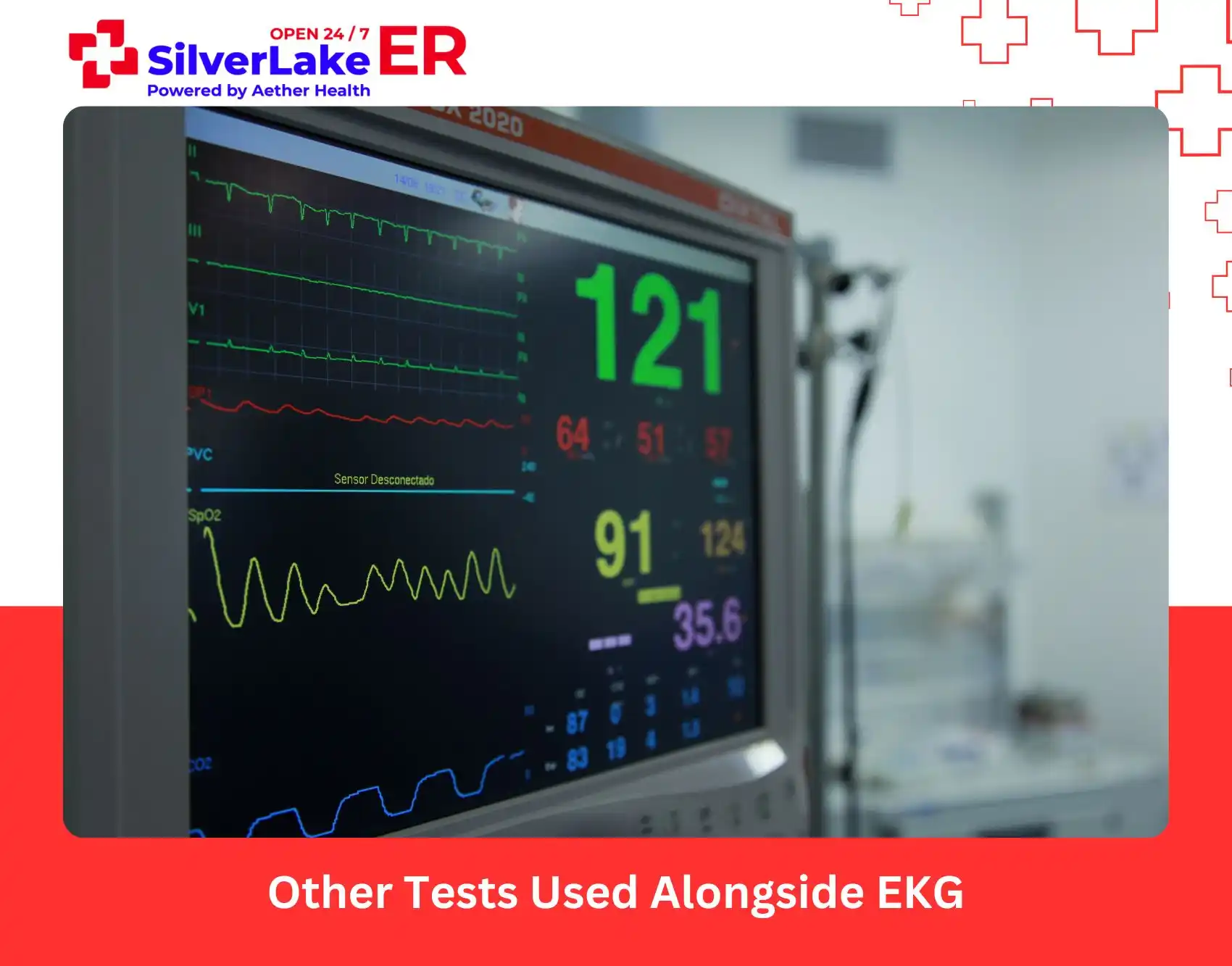
Modern heart attack diagnosis rarely relies on EKG alone. The typical cardiac ER workup pairs EKG with several complementary tests.
- Troponin blood test, which measures a protein released when heart muscle is damaged. Troponin levels rise within hours of a heart attack and remain elevated for days.
- Echocardiogram, an ultrasound of the heart that shows how well each chamber is pumping and whether specific wall segments are damaged.
- Chest X-ray, which rules out other causes of chest pain such as pneumonia, aortic issues, or lung problems.
- CT angiography, when more detailed imaging of the coronary arteries is needed to confirm or rule out blockage.
- Continuous cardiac monitoring to detect arrhythmias that might not appear on a single-strip EKG.
Our imaging done during the same ER visit includes CT, X-ray, and ultrasound capabilities, so the full cardiac workup can be completed without transferring to another facility.
When to Call 911 for a Possible Heart Attack
No test matters if you wait too long to be tested. The National Heart, Lung, and Blood Institute emphasizes that heart muscle begins dying within minutes of a blockage, so recognizing the symptoms and acting fast is more important than knowing what the EKG will eventually show.²
| Call 911 Immediately If You Have Any Of These Signs
These signs can indicate an active heart attack. Do not drive yourself. Paramedics can begin EKG monitoring and treatment on the way to the hospital. |
▶ Chest pain, pressure, squeezing, or heaviness lasting more than a few minutes.
▶ Discomfort radiating to the arm (especially left), jaw, neck, back, or upper abdomen.
▶ Sudden shortness of breath, with or without chest discomfort.
▶ Cold sweat, nausea, or lightheadedness combined with any of the above.
▶ Unusual fatigue or weakness, especially in women, older adults, or those with diabetes.
▶ Any sense that something is seriously wrong, even if symptoms seem mild.
Chest Symptoms That Could Be a Heart Attack in Pearland?
Fast access to EKG, cardiac lab testing, and imaging makes a measurable difference in heart attack outcomes. Silverlake ER is on-site 24/7 at 2752 Sunrise Blvd, Pearland, TX 77584, with everything needed for complete cardiac workup under one roof. Call +1 (713) 528-8703, walk in anytime, or reach us anytime with questions about cardiac emergency capabilities.
Frequently Asked Questions
Can an EKG detect a heart attack that happened in the past?
Yes, often. Pathologic Q waves and certain T wave abnormalities can indicate a prior heart attack, even one you did not know you had. This is called a silent heart attack, and the EKG may be the first clue it occurred.
How accurate is an EKG for detecting a heart attack?
A 12-lead EKG detects most STEMI heart attacks accurately within minutes. Overall sensitivity for all types of heart attacks is around 55 to 65 percent on a single reading. Combining EKG with troponin blood tests brings diagnostic accuracy well above 95 percent.
Does a normal EKG mean I am not having a heart attack?
Not necessarily. Early-presenting heart attacks, non-STEMI attacks, posterior wall attacks, and silent attacks can all produce normal or near-normal EKG readings. If chest symptoms are concerning, blood tests and repeat EKGs are often needed to confirm or rule out an attack.
How quickly do EKG results come back in the ER?
Almost immediately. The EKG strip prints within seconds, and an emergency physician can interpret it on the spot. This fast turnaround is a key reason EKG is one of the first tests performed on anyone arriving with chest pain or suspected cardiac symptoms.
Is an EKG painful or risky?
No. An EKG is painless, non-invasive, and carries essentially no risk. Electrodes stick to your skin for a few minutes, no electricity enters your body, and nothing is injected or ingested. The test can be repeated as many times as needed.
Call 911 immediately for chest pain or pressure lasting more than a few minutes, discomfort radiating to the arm or jaw, sudden shortness of breath, cold sweat with nausea, or any sense that something is seriously wrong. Do not wait for an EKG to confirm what your symptoms are already telling you.