

You wake up with a sore throat that keeps getting worse. Your child cuts their hand on a Sunday afternoon. You need a school physical by next week. Suddenly you’re standing in your kitchen trying to figure out whether to book with a doctor, drive to a walk-in place, or head somewhere else entirely. Understanding the difference between a medical clinic and urgent care makes these decisions easier, faster, and often cheaper.
Both medical clinics and urgent care centers serve important roles in the U.S. healthcare system, but they were designed for different kinds of situations. This guide compares them side by side, walks through when to choose each one, and explains when neither is the right answer. For genuine emergencies in the Pearland area, Aether Health – Silverlake ER provides 24/7 emergency care that goes beyond what either clinics or urgent care centers can offer.
Quick Answer
The main difference between medical clinic and urgent care is that a medical clinic focuses on scheduled, ongoing primary care with an established provider, while urgent care handles same-day walk-in visits for minor illnesses and injuries that can’t wait for a clinic appointment. Medical clinics are best for routine checkups, chronic condition management, and non-urgent concerns. Urgent care is best for evening or weekend needs, minor injuries, and moderate illnesses when your regular provider isn’t available. Neither one handles true emergencies. Those require an emergency room.
What Is a Medical Clinic?

A medical clinic is a healthcare facility where patients see doctors, nurse practitioners, or physician assistants on a scheduled basis. Most clinics operate during standard business hours, Monday through Friday, and require appointments. They focus on preventive care, ongoing management of chronic conditions like diabetes or high blood pressure, annual physicals, vaccinations, and non-urgent medical concerns.
The provider at a medical clinic often becomes your primary care physician, meaning they know your medical history, coordinate specialist referrals, and manage long-term health goals. Federally supported community health centers alone provide care to more than 30 million Americans each year, and traditional medical clinics of all types serve millions more.
What Is Urgent Care?

Urgent care is a walk-in medical facility designed for same-day treatment of minor illnesses and injuries that need attention sooner than a clinic appointment allows but aren’t serious enough to require an emergency room. Most urgent care centers are open evenings and weekends, accept walk-ins, and can typically see patients within an hour.
Urgent care centers are staffed by physicians, nurse practitioners, or physician assistants who can treat things like ear infections, urinary tract infections, minor cuts needing stitches, sprains and strains, mild asthma flare-ups, and flu-like illnesses. They usually have basic on-site X-ray capabilities and can run limited lab tests, but they don’t handle major trauma, cardiac events, strokes, or other life-threatening emergencies.
Medical Clinic vs Urgent Care: Side-by-Side Comparison
The following table breaks down the difference between medical clinic and urgent care across the features that matter most in daily decision-making. Use it to match your situation to the right type of care.
| Feature | Medical Clinic | Urgent Care |
| Hours | Weekdays, standard business hours | Evenings, weekends, extended hours |
| Appointment needed | Yes, usually required | No, walk-ins accepted |
| Typical wait | Depends on scheduling | Usually 30-60 minutes |
| Providers | Primary care physician, NP, PA | Physician, NP, or PA on shift |
| Best for | Routine care, chronic conditions, physicals | Minor illness, minor injury, same-day needs |
| On-site imaging | Typically none | Basic X-ray usually available |
| On-site lab | Sometimes, basic tests | Limited rapid tests |
| Cost range | Lower for insured routine visits | Moderate, higher than clinic |
| Continuity of care | Ongoing relationship | Single-visit focus |
| Can prescribe medications | Yes | Yes |
When to Choose a Medical Clinic
A medical clinic is usually the right choice when you have time to schedule an appointment and your condition isn’t urgent. Consider a medical clinic for the following situations.
- Annual physicals, wellness checkups, and preventive screenings.
- Management of chronic conditions like high blood pressure, diabetes, or asthma.
- Prescription refills and medication reviews with your regular provider.
- Vaccinations, immunizations, and travel health preparation.
- Non-urgent concerns that have been going on for weeks and don’t need immediate attention.
- Specialist referrals and care coordination.
When to Choose Urgent Care
Urgent care fills the gap when you need same-day attention but your regular clinic isn’t open or available. Urgent care visits have grown significantly in recent years as patients seek faster alternatives to scheduled appointments. Consider urgent care for the following.
- Sore throats, ear infections, sinus infections, and flu-like symptoms.
- Minor cuts that may need stitches but aren’t deep or bleeding heavily.
- Sprains, strains, and possible minor fractures where imaging is helpful.
- Urinary tract infections, rashes, and pink eye.
- Mild asthma flare-ups when your inhaler isn’t giving full relief.
- After-hours needs when your primary care provider is closed.
When Neither Is Enough: The Emergency Room Option
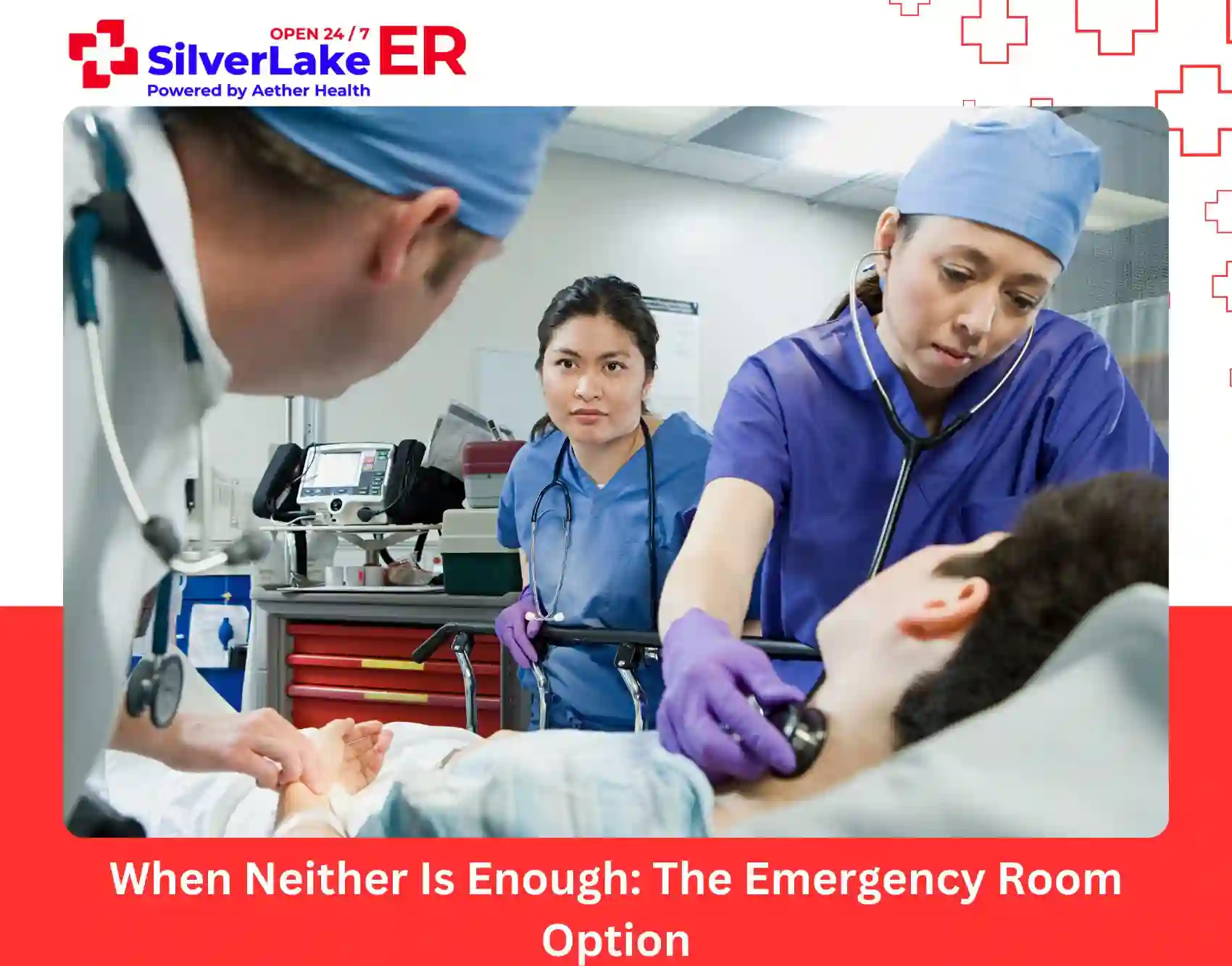
A third option exists between the medical clinic and urgent care levels: freestanding emergency rooms. When your condition is more serious than urgent care can handle (chest pain, severe abdominal pain, suspected stroke, major trauma, difficulty breathing, or any life-threatening symptom), an ER is the right choice. Our severe emergency care team at Silverlake ER is equipped to handle emergencies that go far beyond typical urgent care capabilities, with hospital-grade imaging, on-site labs, and board-certified emergency physicians available 24/7.
For moderate emergencies that don’t rise to the level of critical (deep lacerations needing complex repair, significant fractures, moderate infections needing IV antibiotics), our minor emergencies center offers ER-level care with typically shorter wait times than a hospital emergency department. To learn more about our freestanding ER and how it differs from both clinics and urgent care, visit our About Us page.
Frequently Asked Questions
Is urgent care more expensive than a medical clinic?
Usually yes. Urgent care visits typically cost more than a routine clinic appointment because of the convenience of walk-in access and extended hours. However, urgent care is often significantly less expensive than an emergency room visit for the same minor condition.
Do I need insurance to visit urgent care or a medical clinic?
No, but insurance significantly reduces your out-of-pocket cost at both. Uninsured self-pay rates vary by facility. Most urgent care centers and clinics post their basic self-pay pricing, and community health centers often offer sliding-scale fees based on income.
Can urgent care handle chest pain or stroke symptoms?
No. Chest pain, sudden severe headache, one-sided weakness, slurred speech, difficulty breathing, or any suspected stroke or heart attack symptoms require an emergency room, not urgent care. Call 911 or go to the nearest ER immediately.
What’s the wait time difference between a clinic and urgent care?
A medical clinic appointment is scheduled in advance, so your wait once you arrive is usually short. Urgent care is walk-in, so wait time depends on how busy the facility is when you arrive, typically 30-60 minutes but sometimes longer during flu season or evenings.
Can I switch between a clinic and urgent care for the same condition?
Yes, but continuity of care matters. If you start treatment at urgent care and the condition doesn’t resolve, share the visit records with your primary care clinic so they have the full picture. This helps avoid duplicate tests and conflicting treatment plans.
When You Need More Than a Clinic or Urgent Care in Pearland
Understanding the difference between medical clinic and urgent care helps you make faster, better decisions about where to go. But when your situation goes beyond what either can handle, Aether Health – Silverlake ER is on-site 24/7 at 2752 Sunrise Blvd, Pearland, TX 77584. Board-certified emergency physicians, hospital-grade imaging, and full lab capabilities are available around the clock. Call +1 (713) 528-8703 or walk in anytime.
Call 911 immediately for life-threatening emergencies including chest pain, stroke symptoms, severe difficulty breathing, major trauma, or loss of consciousness. Neither a medical clinic nor urgent care is equipped for these situations. An emergency room or 911 response is required.