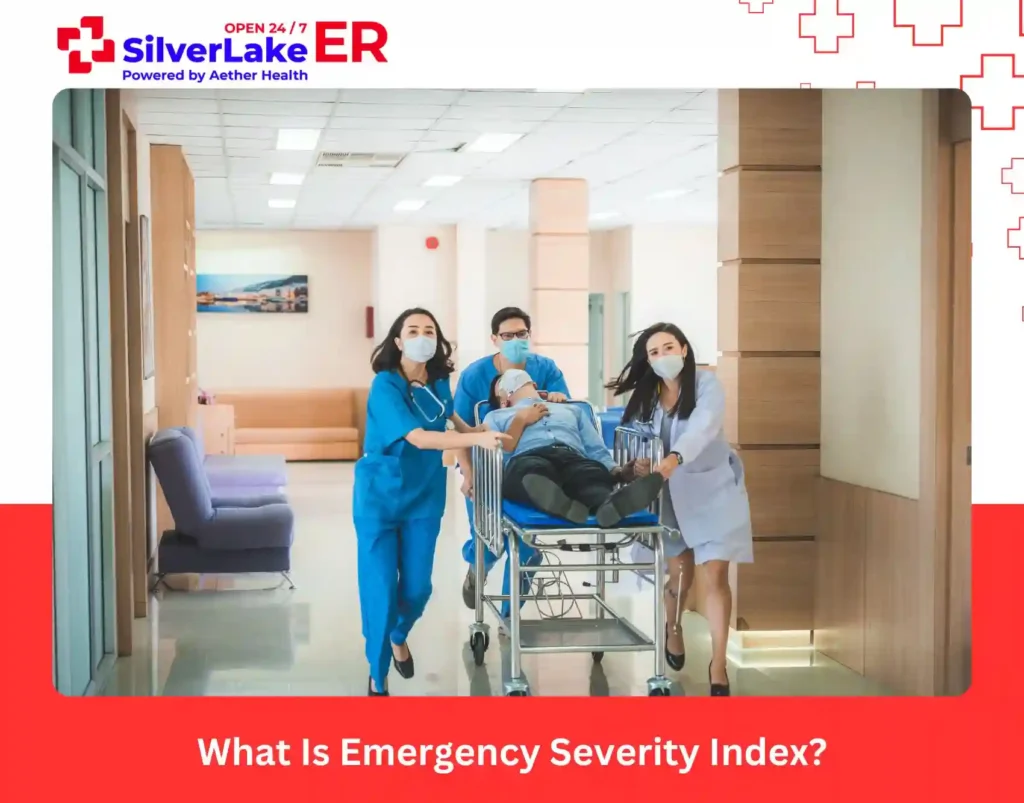
You walk into the ER holding your child’s cut finger. The person ahead of you was clutching their chest. Ten minutes later, a paramedic team wheels in someone unconscious on a stretcher. Suddenly the room feels chaotic, and it seems like you’ll be waiting forever.
What’s actually happening behind that intake desk is a highly structured system called the Emergency Severity Index (ESI). It’s how emergency departments decide who gets seen first and why. Understanding it can turn frustration into clarity, and help you make better decisions about where to go for care. If you’re near Pearland and need to know whether your situation is emergency-level, Aether Health – Silverlake ER is open 24/7 for both severe and moderate emergencies.
The Short Answer
The Emergency Severity Index (ESI) is a five-level triage system used in most U.S. emergency departments to sort patients by how sick or injured they are. A triage nurse assigns each arriving patient a level from 1 (most critical, needs immediate resuscitation) to 5 (least urgent, no ER resources needed). Higher priority patients are seen first, regardless of who arrived first. ESI is designed to keep the sickest patients alive while managing limited staff and space.
How the Emergency Severity Index Works
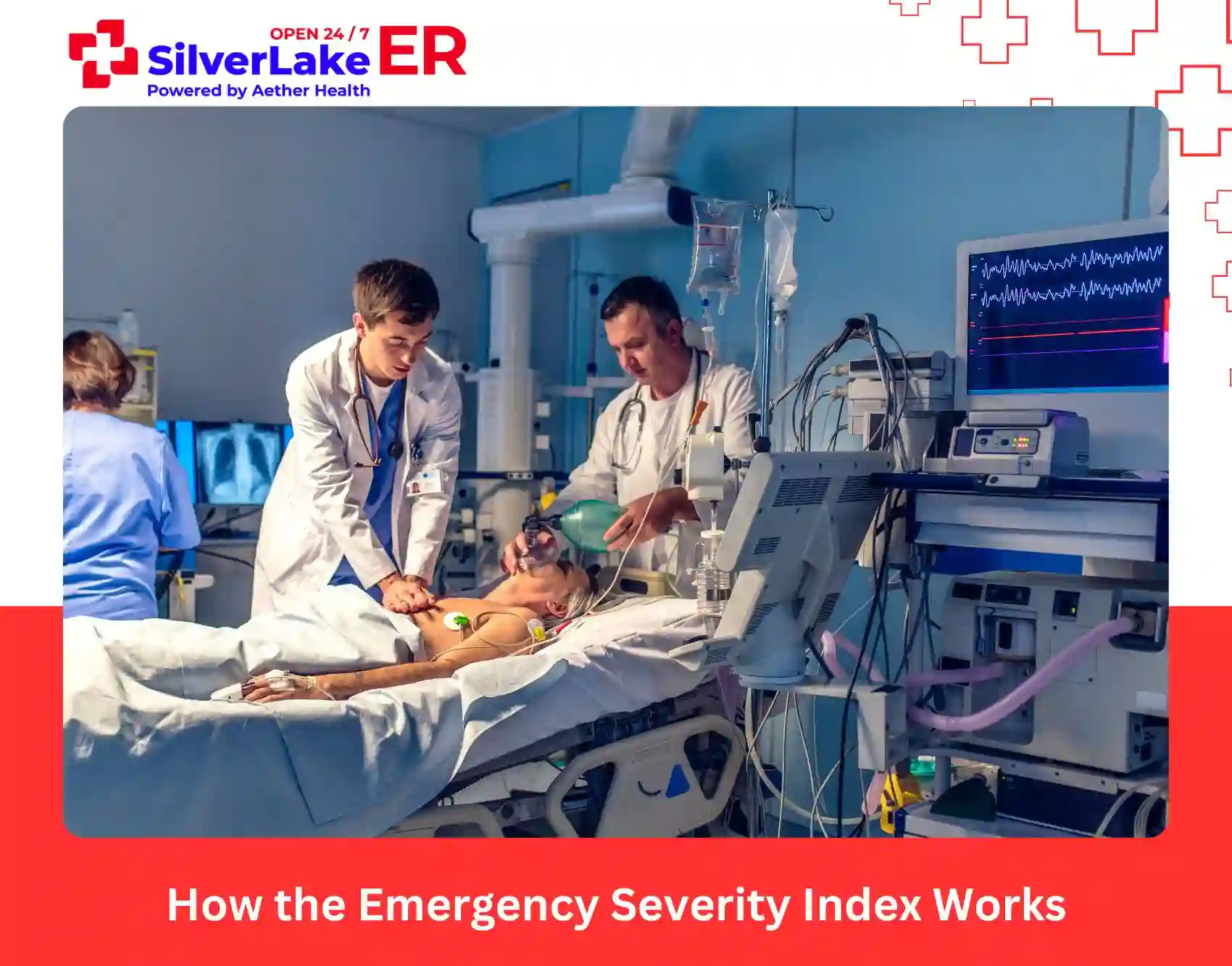
The Emergency Severity Index uses two questions to sort every patient. First: is the person’s condition life-threatening or does it require immediate intervention? Second: how many ER resources will the patient likely need (blood work, imaging, IV medications, specialist consults)? A clinical reference published by the National Library of Medicine describes ESI as the most widely adopted five-level triage tool in U.S. emergency departments, precisely because it combines both acuity and predicted resource use in one decision.¹
This dual approach matters because it protects the sickest patients while also flowing lower-acuity cases through faster. A person with a life-threatening condition jumps to the front of the line. A person who needs many tests goes ahead of someone who needs one. And someone with a minor scrape can often be seen quickly by a physician assistant without pulling major resources.
The 5 ESI Levels Explained
Every ESI level has a specific meaning, a rough wait time expectation, and typical example conditions. Here’s what each level really means.
ESI Level 1 (Resuscitation). Immediate, life-threatening. The patient needs life-saving intervention right now. Wait time: zero. Example conditions include cardiac arrest, respiratory arrest, major trauma with active bleeding, and severe stroke within the treatment window. Level 1 patients bypass the waiting room entirely.
ESI Level 2 (Emergent). High-risk situation that could become life-threatening. Wait time: usually under 10 minutes. Example conditions include chest pain with cardiac features, severe shortness of breath, altered mental status, signs of stroke, severe abdominal pain, and suspected sepsis. Level 2 patients are also fast-tracked, though not quite as urgently as Level 1.
ESI Level 3 (Urgent). Stable but needs multiple resources like lab work, imaging, and IV medications. Wait time: varies widely, sometimes 30 minutes to a few hours. Example conditions include moderate abdominal pain requiring evaluation, moderate injuries needing imaging, and infections requiring IV antibiotics. This is where most ER patients land.
ESI Level 4 (Less Urgent). Stable and needs only one ER resource. Wait time: often 1 to 3 hours during busy periods. Example conditions include a simple laceration requiring stitches, a minor injury needing one X-ray, or a possible urinary tract infection needing one test. Level 4 patients are stable but still benefit from ER care.
ESI Level 5 (Non-urgent). Stable, and needs no ER resources beyond a physical exam. Wait time: can be the longest, sometimes 2 to 4 hours. Example conditions include a medication refill, a minor rash, a well-controlled chronic issue, or a prescription-related question. Level 5 patients could often be treated in a clinic instead of an ER.
How the Triage Nurse Decides Your Level
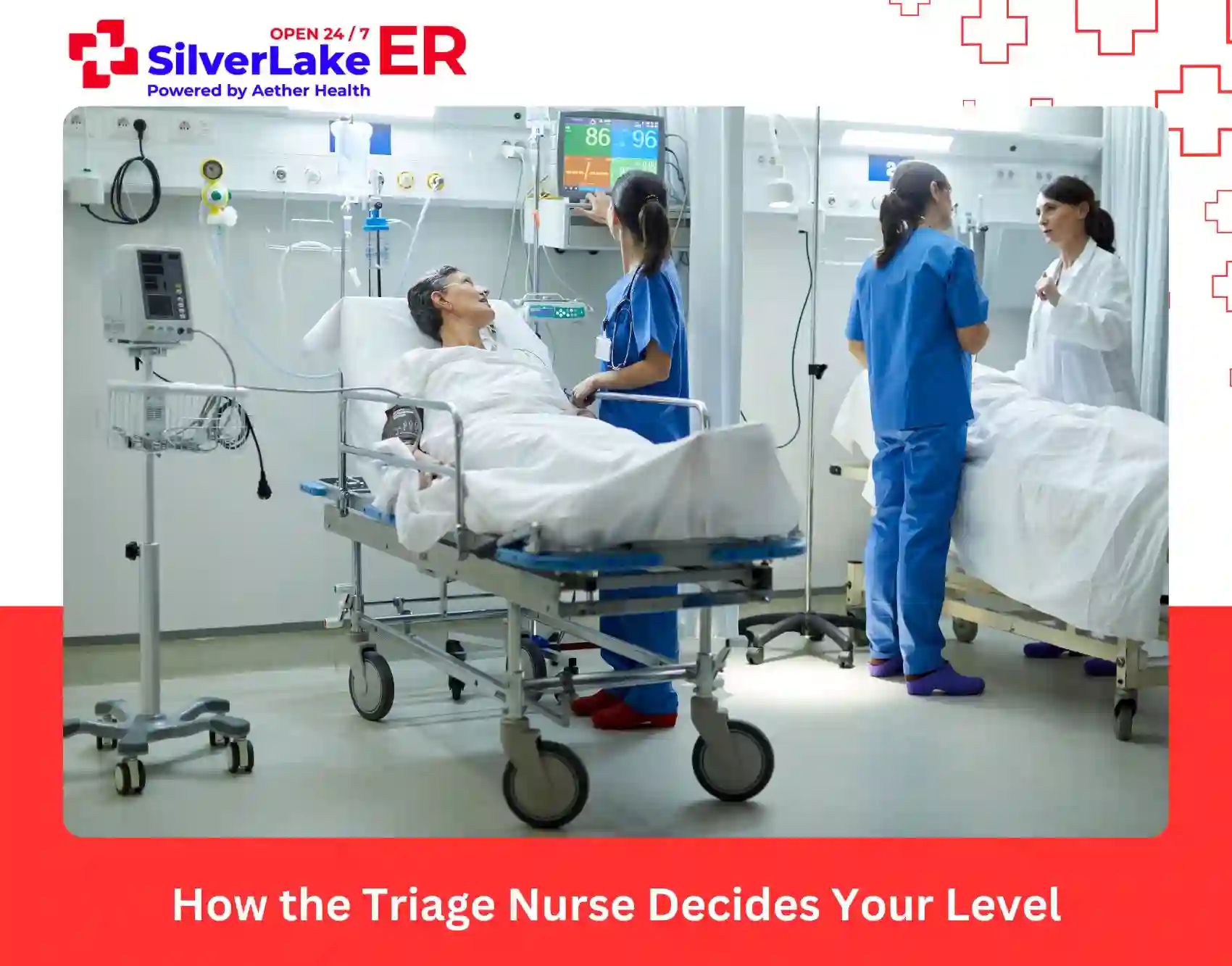
The triage nurse is usually the first medical professional you meet. In a rapid assessment lasting 2 to 5 minutes, they check vital signs, ask about your chief complaint, review your medical history, and observe how you look and act. Based on these findings, they assign an ESI level.
The American College of Emergency Physicians notes that triage decisions can be reassessed as symptoms change. If a Level 4 patient suddenly gets worse in the waiting room, they can be upgraded to Level 2 immediately. This is why ER staff monitor the waiting room, not just the treatment area, and why you should always tell staff if your symptoms worsen.²
What Patients Often Get Wrong About ESI
A few common misconceptions cause frustration. First: ESI is not first-come, first-served. Someone who arrived after you can absolutely be seen before you if their condition is more critical. This is by design, not by mistake.
Second: a longer wait doesn’t mean the ER doesn’t care. It usually means your condition, while real and worth evaluating, isn’t at risk of getting dangerously worse in the next few hours. That’s actually good news.
Third: being triaged as Level 4 or 5 doesn’t mean you shouldn’t be there. It might mean, however, that a lower-acuity setting could have served you faster. Understanding ESI helps you match your situation to the right level of care.
What ESI Means for Your Wait Time
Wait time isn’t just about who was there first. It’s about acuity plus current department capacity. If the ER is dealing with three Level 1 patients at once, everyone else waits. If it’s quiet and you’re a Level 3, you might be seen fast.
If your condition is genuinely severe, don’t wait it out at home. Our severe emergency care team is equipped for Level 1 and Level 2 situations 24/7. For moderate or minor conditions that still need real medical attention, our minor emergencies center handles Level 3 through Level 5 conditions with shorter wait times than a hospital ER.
Frequently Asked Questions
Do all U.S. emergency departments use the Emergency Severity Index?
The majority do. ESI is the most widely adopted triage tool in U.S. emergency departments, though a small number use alternative systems like the Canadian Triage and Acuity Scale (CTAS) or the Manchester Triage System.
Can my ESI level change while I’m waiting?
Yes. If your condition worsens or new symptoms appear, you can and should be reassessed. Tell any staff member if your pain increases, breathing changes, or you feel much worse. Reassessment can move you to a higher priority.
What is the difference between an ER and lower-acuity care?
An ER handles all ESI levels but is designed and staffed for Level 1 through 3. Lower-acuity clinics handle stable conditions that don’t need major imaging, IV medications, or intensive monitoring. Freestanding ERs like Silverlake bridge both, offering hospital-grade ER capabilities with shorter waits.
How long does an ESI triage assessment take?
Usually 2 to 5 minutes. The triage nurse checks your vital signs, asks about your main complaint, reviews basic medical history, and observes your appearance and behavior. Based on that, they assign a Level 1 through 5.
Does insurance treat all ESI levels the same?
Coverage rules vary by insurer and plan. Most insurance plans cover emergency care regardless of the eventual ESI level, but you should always confirm your specific plan’s rules. Aether Health Silverlake ER accepts most commercial insurance.
Know Where to Go for Your Level of Care
Understanding the Emergency Severity Index helps you make better decisions about where to seek care. For Level 1 and 2 conditions, always call 911 or go to the nearest ER immediately. For Level 3 through 5 conditions, a freestanding ER can often provide faster care than a large hospital emergency department, without sacrificing quality.
Aether Health Silverlake ER handles all five ESI levels 24 hours a day at 2752 Sunrise Blvd, Pearland, TX 77584. Board-certified emergency physicians, on-site imaging and lab, and shorter wait times than typical hospital ERs. Call +1 (713) 528-8703 or walk in anytime.
External References Links :
1. clinical reference published by the National Library of Medicine
2. American College of Emergency Physicians