
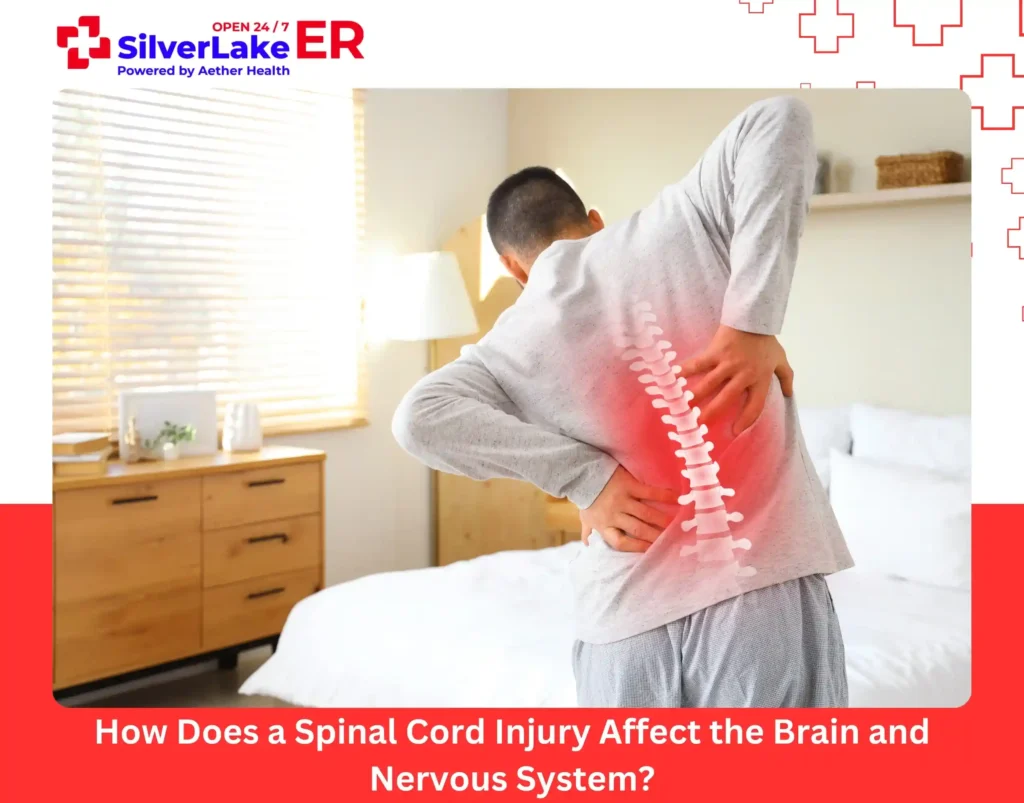
Most people think of a spinal cord injury as a back or neck problem something that affects movement and sensation below the site of damage. The reality is more complex. The brain and the spinal cord are two halves of one central nervous system, in constant two-way communication. When the spinal cord is injured, the brain doesn’t just lose contact with part of the body it physically changes.
Understanding how a spinal cord injury affects the brain helps patients and families set realistic expectations for recovery, plan rehabilitation, and watch for complications that aren’t always obvious. This guide breaks down the science in plain language: how the brain and spinal cord work together, what happens the moment an injury occurs, how the brain itself adapts in the months and years that follow, and what kinds of complications need urgent medical attention.
At Aether Health – Silverlake ER in Pearland, TX, our board-certified emergency physicians treat spinal injuries and their complications 24/7.
1. The Brain–Spinal Cord Connection: One System, Two Parts
The brain and spinal cord together form the central nervous system (CNS). The brain is the command center making decisions, processing information, generating emotion, and storing memory. The spinal cord is the high-speed cable that connects the brain to the rest of the body.
Every voluntary movement, every sensation, every involuntary function like heart rate and blood pressure depends on signals traveling along this pathway.
Information travels in both directions. Motor signals leave the brain and travel down the cord to muscles. Sensory signals touch, pain, temperature, position travel up the cord to the brain. Autonomic signals control internal organs and travel in both directions, often without conscious awareness.
The spinal cord isn’t just a passive cable; it processes some reflexes on its own and modulates the signals it carries.
Key concept: A spinal cord injury isn’t a problem just below the injury site. It changes how the entire nervous system including the brain operates.
2. What Happens at the Moment of Injury

A spinal cord injury (SCI) occurs when trauma, disease, or compression damages the cord. The most common causes include vehicle accidents, falls, sports injuries, violence, and certain medical conditions like tumors or infections.
At the moment of impact, two things happen:
- Primary injury The immediate physical damage from the trauma itself: bruising, tearing, compression, or transection of the spinal cord.
- Secondary injury A cascade of biological events that unfolds over hours and days after the initial trauma: swelling, inflammation, reduced blood flow, oxygen deprivation, and chemical damage to surrounding nerve cells. Secondary injury often causes more harm than the primary trauma.
Within seconds of the injury, signal transmission between the brain and the body below the injury site is disrupted. Depending on whether the injury is complete (full loss of signal) or incomplete (partial signal preserved), the consequences range from temporary impairment to permanent paralysis.
3. How SCI Disrupts Communication Between Brain and Body
The brain doesn’t go quiet after an SCI. It keeps generating signals, sending commands, and receiving feedback. The problem is that those signals can’t get through past the injury site. The disruption affects three distinct signal systems:
Motor Signals (Voluntary Movement)
When you decide to move a hand or take a step, the brain generates an electrical command that travels down the spinal cord to the muscle. After an SCI, that command can be blocked, slowed, or scrambled. The result is muscle weakness, paralysis, or loss of coordination below the injury level.
The higher the injury on the spinal cord, the more of the body is affected an injury in the neck (cervical region) affects far more than one in the lower back.
Sensory Signals (Touch, Pain, Temperature, Position)
Sensory information from the body travels up the cord to the brain. After an SCI, this flow can be interrupted, dulled, or distorted.
Patients may experience numbness, tingling, hypersensitivity, or paradoxically neuropathic pain in body parts they otherwise can’t feel. The brain still generates pain perception, even when there’s no clear sensory input coming in.
Autonomic Signals (Internal Body Control)
The autonomic nervous system controls heart rate, blood pressure, digestion, temperature regulation, bladder and bowel function, and sexual function all without conscious thought.
SCIs above a certain level disrupt this system significantly, which can cause dangerously low or unstable blood pressure, problems with temperature control, and a serious complication called autonomic dysreflexia (covered in Section 6).
4. Structural and Functional Changes in the Brain After SCI
This is where the brain side of the story gets interesting and where most articles stop short. Research over the past two decades has shown that the brain physically changes after a spinal cord injury, not just metaphorically.
Cortical Reorganization (Neuroplasticity)
The brain maps the body in a region called the somatosensory cortex. After an SCI, the parts of the cortex that used to receive signals from paralyzed body areas don’t go dormant they get reassigned. The brain regions next door expand into the unused territory.
This is part of what makes rehabilitation possible: the brain is actively reorganizing in response to the new input it’s receiving.
Gray Matter and White Matter Changes
MRI studies show measurable changes in brain volume after SCI. Gray matter (neuron cell bodies) can shrink in motor and sensory regions corresponding to the affected body parts. White matter (the nerve fiber connections between regions) can also show changes in integrity. These changes can occur within months of the injury and continue for years.
Changes in Brain Connectivity
The brain operates as a network of connected regions. After an SCI, the patterns of communication between these regions reorganize.
Some connections weaken; others strengthen as the brain compensates. Functional imaging shows that motor planning, attention, and sensory processing networks can all shift in patients with chronic SCI.
Hormonal and Chemical Changes
The injury also affects neurotransmitter levels and hormone regulation. Cortisol (the stress hormone), serotonin, dopamine, and other chemical messengers can all shift in response to the injury, contributing to both physical and psychological symptoms.
5. Cognitive, Emotional, and Mental Health Effects
Spinal cord injuries don’t directly damage the brain in the way a traumatic brain injury does but they significantly affect how the brain functions. Some of these effects are biological. Some are psychological. Most are a combination of both.
Cognitive Effects
Roughly 30–60% of SCI patients show some cognitive impairment, especially in:
- Attention and concentration
- Processing speed
- Memory, particularly short-term and working memory
- Executive functions like planning and decision-making
Part of this is due to the brain changes described in Section 4. Part is due to chronic pain, fatigue, medication side effects, and sleep disturbance. Concurrent traumatic brain injury (TBI), which occurs in up to 60% of high-impact SCI cases, also contributes significantly.
Emotional and Mental Health Effects
The psychological impact of an SCI is substantial. Rates of depression, anxiety, and post-traumatic stress disorder are significantly higher in SCI patients than in the general population. Common challenges include:
- Depression affects roughly 1 in 4 SCI patients
- Anxiety, especially health-related and social anxiety
- Post-traumatic stress symptoms, particularly when the injury was sudden or violent
- Grief and adjustment difficulties
- Sleep disorders, including insomnia and sleep apnea
Mental health treatment is now considered a core part of SCI rehabilitation not an optional add-on. Untreated depression and anxiety are associated with worse physical outcomes, lower rehabilitation engagement, and higher rates of secondary complications.
6. Secondary Complications That Affect the Brain
Beyond the direct effects of the injury, SCI sets the stage for several complications that can affect brain function and require emergency care.
Autonomic Dysreflexia (AD)
This is a medical emergency that occurs primarily in patients with SCI at or above the T6 level. A triggering stimulus below the injury (often a full bladder, bowel impaction, or pressure sore) causes a runaway spike in blood pressure.
Without rapid treatment, AD can cause stroke, seizure, or death. Symptoms include sudden severe headache, flushed skin above the injury, sweating, nasal congestion, and dangerously high blood pressure. If suspected, this is an immediate ER visit.
Chronic Neuropathic Pain
Up to two-thirds of SCI patients experience chronic neuropathic pain burning, shooting, or electrical sensations originating from the damaged nervous system itself.
This pain alters brain processing over time and is closely linked with depression, sleep disruption, and cognitive impairment.
Pressure Injuries and Infections
Reduced mobility raises the risk of pressure ulcers, urinary tract infections, and respiratory infections. Severe infections (sepsis) can cause confusion, delirium, and lasting cognitive effects, especially in older patients.
Respiratory Complications
High cervical injuries can weaken the muscles used for breathing, leading to chronic respiratory issues and a higher risk of pneumonia. Oxygen deficiency from any respiratory crisis affects brain function quickly and severely.
Cardiovascular Issues
SCI patients face higher long-term risk of heart disease, stroke, and blood clots all of which can damage the brain directly if they occur.
If a person with an SCI develops sudden severe headache, confusion, breathing difficulty, fever, chest pain, or dangerously high blood pressure go to the ER immediately. At Aether Health – Silverlake ER, you’ll be seen right away, 24/7.
7. Recovery and Rehabilitation Insights
Recovery from SCI is highly individual, depending on the level and completeness of the injury, the patient’s overall health, and the quality and consistency of rehabilitation. The good news: the brain’s ability to reorganize itself neuroplasticity opens a meaningful window for improvement, especially in the first months and years after injury.
How the Brain Heals and Adapts
- Cortical regions remap based on the input they receive repeated, consistent rehabilitation drives lasting change
- Neural pathways that were dormant or partially preserved can strengthen with use
- Compensatory networks can develop, allowing patients to perform tasks through new patterns of brain activity
- Spared nerve fibers below the injury site can sometimes be trained to carry more signal
Evidence-Based Approaches
- Intensive physical and occupational therapy, especially in the first 12–18 months
- Task-specific repetitive training to drive cortical reorganization
- Functional electrical stimulation (FES) to maintain muscle activity and stimulate neural pathways
- Robotic and exoskeleton-assisted training in some rehabilitation centers
- Cognitive rehabilitation when memory, attention, or executive function are affected
- Mental health support throughout the recovery process
Recovery is rarely linear, and gains can continue for years after the initial injury. New research into stem cell therapies, neuromodulation, and brain–computer interfaces continues to expand what’s possible, though most of these remain experimental.
8. When to Seek Emergency Care at Aether Health – Silverlake ER

Spinal cord injuries and the complications that come with them are time-critical emergencies. Whether someone is experiencing a new suspected SCI from trauma or a known SCI patient is showing signs of a serious complication, every minute matters. As a full-service freestanding ER in Pearland, TX, Aether Health – Silverlake ER is equipped to deliver hospital-level care 24/7 without long waits.
Our spinal injury and neurological emergency capabilities include:
- Rapid evaluation by board-certified emergency physicians
- On-site CT and X-ray imaging for spinal evaluation
- Full laboratory services for rapid diagnostic testing
- Spinal precautions and immobilization protocols
- Emergency management of autonomic dysreflexia and other SCI complications
- Continuous cardiac, respiratory, and neurological monitoring
- Pain management and IV therapy
- Direct hospital transfer coordination when admission or specialized care is needed
We also operate on a no balance billing policy for insured patients because medical emergencies shouldn’t come with billing ambushes.
If trauma is suspected fall, vehicle accident, sports injury do not move the person unless they are in immediate danger. Call 911 and keep them still until help arrives. Improper movement can worsen a spinal injury.
Frequently Asked Questions
Does a spinal cord injury cause brain damage?
Not directly. A spinal cord injury damages the spinal cord, not the brain itself. However, brain function and structure can change significantly after an SCI due to neuroplasticity, loss of sensory input, and downstream complications. In high-impact trauma, a concurrent traumatic brain injury is also possible and statistically common.
Can a spinal cord injury affect memory or thinking?
Yes. Many SCI patients experience some degree of cognitive impairment, especially in attention, processing speed, and memory. This is influenced by brain changes, chronic pain, fatigue, sleep problems, medications, and concurrent traumatic brain injury when present.
Why do SCI patients have a higher rate of depression and anxiety?
Multiple reasons biological changes in brain chemistry, chronic pain, sleep disruption, loss of independence, and the psychological adjustment to a major life change. Mental health support is now considered a core part of SCI care, not optional.
Is recovery possible after a spinal cord injury?
Yes, in many cases. The degree of recovery depends on the type and severity of the injury, the patient’s overall health, and the rehabilitation program. The brain’s neuroplasticity allows for meaningful improvement, especially in the first 12–18 months though gains can continue for years.
What is autonomic dysreflexia and why is it a medical emergency?
Autonomic dysreflexia is a sudden, dangerous spike in blood pressure that can occur in patients with SCI at or above the T6 level. Triggers are usually below the injury often a full bladder or bowel issue. Without rapid treatment, it can cause stroke or seizure. Any SCI patient experiencing sudden severe headache, sweating, or flushing needs emergency evaluation immediately.
Where is Aether Health – Silverlake ER located?
We’re located at 2752 Sunrise Blvd, Pearland, TX 77584, open 24 hours a day, 7 days a week. Call (713) 528-8703 or walk in anytime.
Spinal Cord Emergency? Get Seen Immediately in Pearland, TX
Whether it’s a suspected new spinal injury or a serious complication from an existing SCI, time matters. Walk into Aether Health – Silverlake ER and you’ll be evaluated by a board-certified emergency physician immediately no appointment, no long waits.
📞 Call: (713) 528-8703
📍 Visit: 2752 Sunrise Blvd, Pearland, TX 77584
🌐 Online: sler247.com
🕒 Hours: Open 24/7, 365 days a year
Medical Disclaimer
This article is for general educational purposes only and is not a substitute for professional medical advice, diagnosis, or treatment. If a spinal cord injury is suspected, do not move the person and call 911 immediately. For SCI complications or any medical emergency, call 911 or go to your nearest emergency room.