
Reviewed by the emergency care team at Aether Health Silverlake ER | 2752 Sunrise Blvd, Pearland, TX 77584 | +1 (713) 528-8703
Call 911 immediately: If a person has fallen, been in an accident, or has sudden severe back or neck pain with numbness, weakness, or loss of bladder or bowel control do not move them. Call 911 now. Improper movement can worsen a spinal cord injury. Aether Health Silverlake ER is open 24/7 with on-site imaging at 2752 Sunrise Blvd, Pearland, TX 77584.
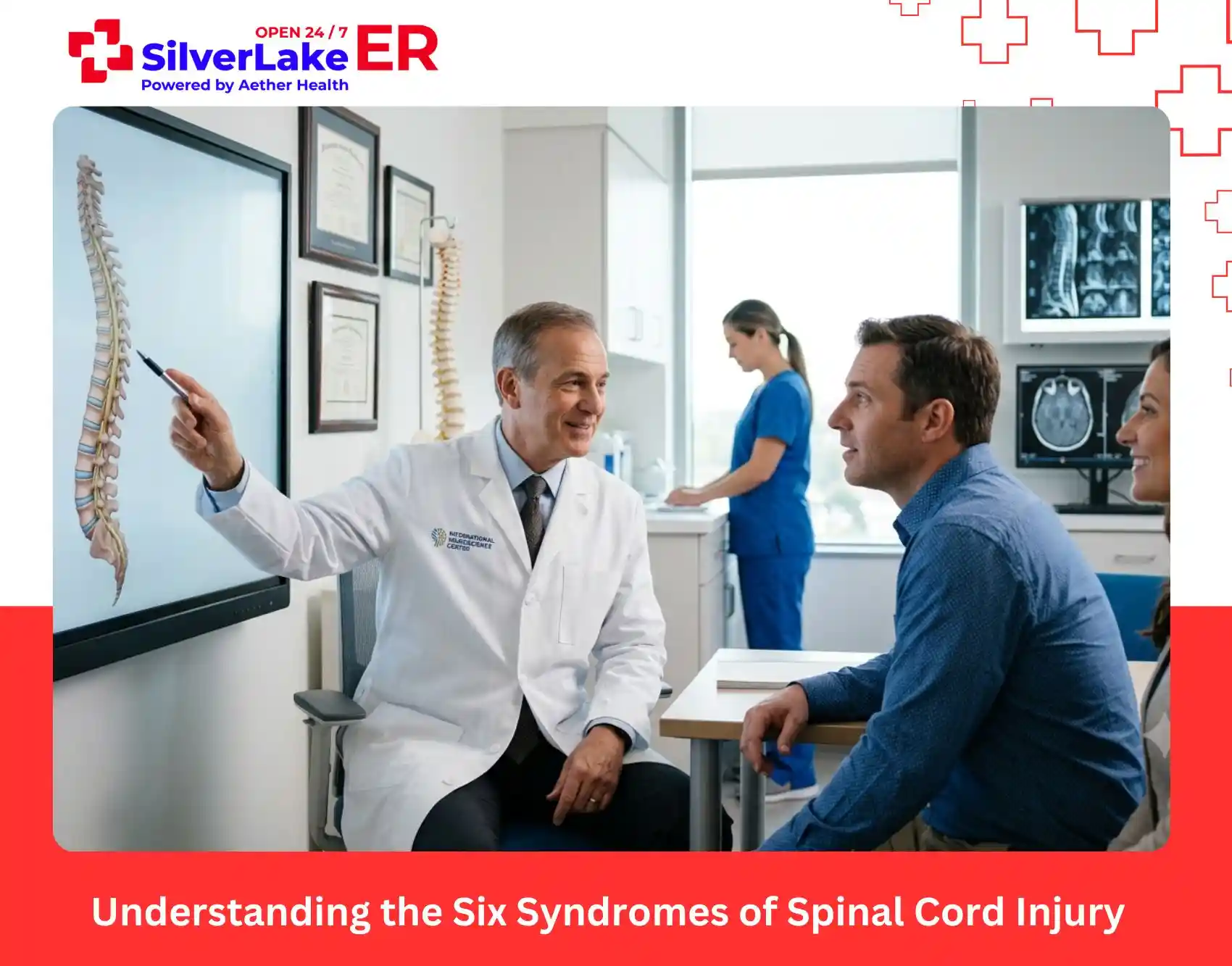
Spinal cord injuries don’t all look the same. Depending on which part of the spinal cord is damaged and how the damage occurred, injuries fall into one of six recognized clinical patterns called spinal cord syndromes. Each has its own signature symptoms, its own level of urgency, and its own long-term implications. Recognizing which pattern is present matters, because every one of them is a medical emergency.
This guide breaks down the six syndromes of spinal cord injury central, anterior, posterior, Brown-Sequard, cauda equina, and conus medullaris what each one feels like, why it matters, and when it needs immediate spinal injury emergency care at Aether Health Silverlake ER.
Quick Answer: What Are the 6 Syndromes of Spinal Cord Injury?
The six syndromes of spinal cord injury are:
(1) Central Cord Syndrome weakness worse in the arms than in the legs, most often from a fall in an older adult;
(2) Anterior Cord Syndrome loss of movement and pain/temperature sensation below the injury, with position sense preserved;
(3) Posterior Cord Syndrome loss of position sense, vibration, and coordination, with movement usually preserved;
(4) Brown-Sequard Syndrome one-sided motor loss with opposite-side loss of pain and temperature sensation, from a hemisection injury;
(5) Cauda Equina Syndrome a surgical emergency involving saddle numbness, bladder/bowel changes, and leg weakness from compression at the base of the spine.
(6) Conus Medullaris Syndrome mixed motor and sensory changes with sudden bladder and bowel dysfunction from injury at the very end of the spinal cord. Any of these signs especially with saddle numbness, bladder changes, or sudden weakness needs immediate emergency evaluation. Suspected spinal injury with numbness or weakness is a medical emergency: call 911.
The 6 Syndromes at a Glance
Use this table as a quick reference. Below it, each syndrome gets a detailed breakdown so you know exactly what to look for and when to act.
| Syndrome | Signature Pattern | Level of Urgency |
| 1. Central Cord Syndrome | Arms weaker than legs, hand grip loss | Immediate, ER evaluation |
| 2. Anterior Cord Syndrome | Movement and pain loss below injury; position sense preserved | Immediate, ER evaluation |
| 3. Posterior Cord Syndrome | Position and vibration loss; coordination difficulty | Immediate, ER evaluation |
| 4. Brown-Sequard Syndrome | One-sided motor loss with opposite-side sensory loss | Immediate, ER evaluation |
| 5. Cauda Equina Syndrome | Saddle numbness + bladder/bowel changes + leg weakness | True surgical emergency, call 911 |
| 6. Conus Medullaris Syndrome | Mixed motor/sensory changes with severe bladder dysfunction | True surgical emergency, call 911 |
Syndrome 1: Central Cord Syndrome
Central cord syndrome is the most common incomplete spinal cord injury. It affects the central part of the spinal cord usually in the cervical (neck) region and often results from a fall in an older adult with existing neck arthritis, or from any sudden hyperextension of the neck. The distinctive feature: weakness is worse in the arms and hands than in the legs.
What central cord syndrome feels like
- Weakness in the arms and hands that is more pronounced than any weakness in the legs.
- Difficulty gripping objects, opening jars, buttoning shirts, or performing fine motor tasks.
- Numbness or burning sensations in the hands and forearms.
- Legs may be affected but usually retain more function.
- Some patients experience bladder problems or difficulty with balance.
Why central cord syndrome matters
Even when leg function is preserved, central cord syndrome represents active spinal cord damage. Delayed evaluation can lead to worsening symptoms, complications, and permanent loss of function. Rapid emergency assessment allows imaging, stabilization, and coordinated care to protect long-term outcomes.
Syndrome 2: Anterior Cord Syndrome
Anterior cord syndrome affects the front two-thirds of the spinal cord. It’s typically caused by direct trauma with a burst fracture, injuries that interrupt blood flow to the anterior spinal artery, or certain vascular events. Because different sensory tracks run through different parts of the cord, this syndrome has a very specific pattern of preserved and lost function.
What anterior cord syndrome feels like
- Loss of movement (motor function) below the level of injury.
- Loss of pain and temperature sensation below the injury.
- Position sense and vibration sensation are preserved you can still feel where your limbs are, even when you can’t move them.
- Bladder and bowel function are commonly affected.
Why anterior cord syndrome matters
Anterior cord syndrome has one of the more challenging prognoses among incomplete spinal cord injuries. Outcomes depend heavily on how quickly the injury is stabilized and how much secondary damage can be prevented. Because it often involves vascular compromise, immediate imaging and emergency spinal injury evaluation are critical to preserving whatever function remains.
Syndrome 3: Posterior Cord Syndrome
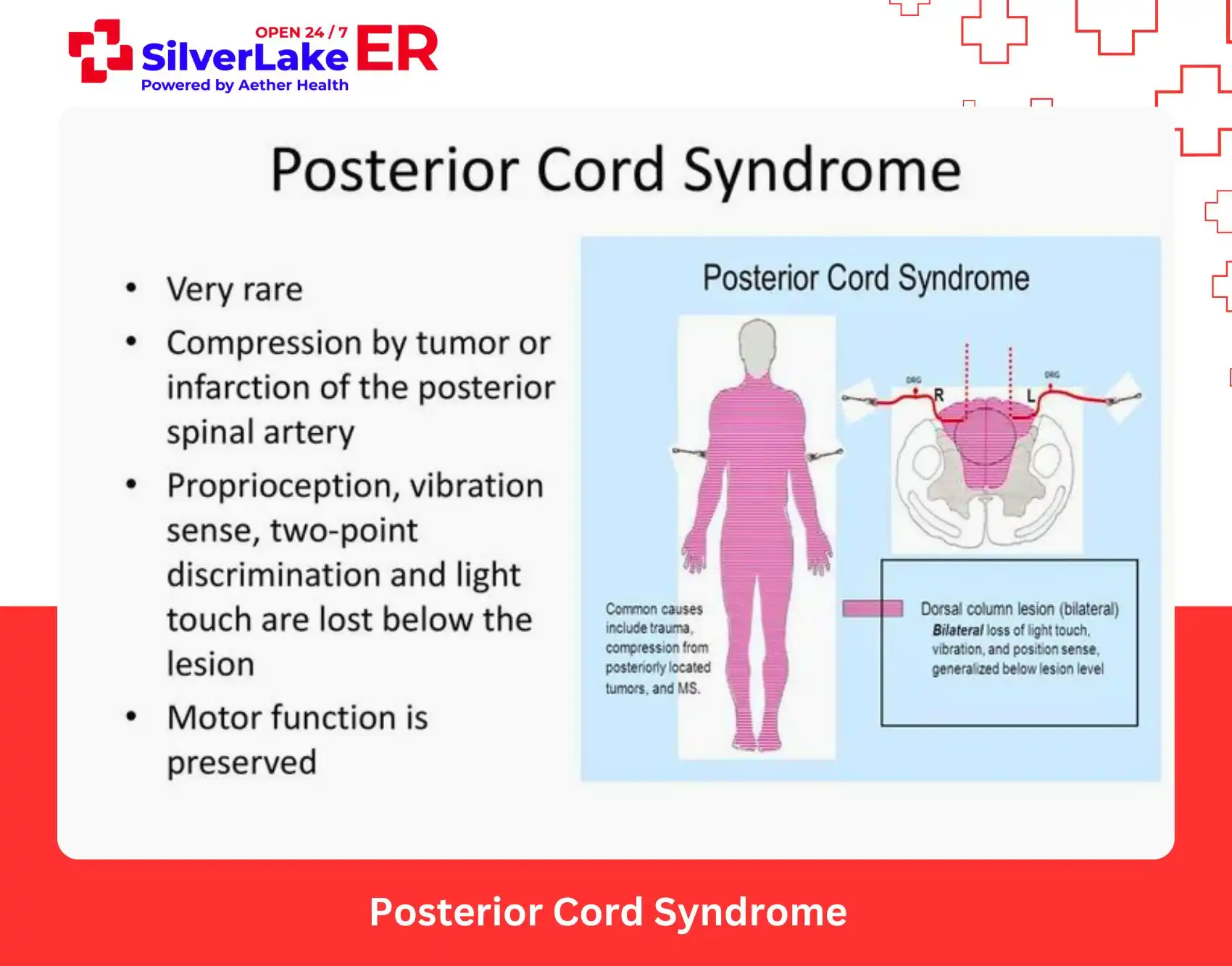
The least common of the six syndromes. Posterior cord syndrome affects the back portion of the spinal cord, which carries specific sensory pathways for position sense (proprioception), vibration, and light touch. Motor function is usually preserved.
What posterior cord syndrome feels like
- Loss of position sense below the injury trouble knowing where your limbs are without looking.
- Loss of vibration sense.
- Ataxia trouble coordinating movement, especially walking.
- Motor function and pain/temperature sensation are usually preserved.
- Increased fall risk because of loss of coordination even when strength is normal.
Why posterior cord syndrome matters
Because strength is often preserved, patients and families sometimes underestimate this syndrome. But loss of position sense is disabling walking safely requires knowing where your feet are without watching them. Falls, secondary injuries, and continued neurological damage are real risks. Immediate ER evaluation identifies the cause and prevents further harm.
Syndrome 4: Brown-Sequard Syndrome
Brown-Sequard syndrome results from damage to one side of the spinal cord called a hemisection. It’s most often caused by penetrating trauma (stab wounds, gunshot injuries, unusual fractures), but can also result from tumors, disc herniations, or vascular events that compress one side of the cord. It produces one of the most distinctive symptom patterns in all of neurology.
What Brown-Sequard syndrome feels like
The classic pattern is opposite on each side of the body:
- Same-side (ipsilateral) loss of motor function below the injury the leg or arm on the injured side can’t move normally.
- Same-side loss of position sense and vibration.
- Opposite-side (contralateral) loss of pain and temperature sensation the limb on the uninjured side feels numb to sharp objects or heat.
This split pattern happens because different sensory tracks cross the spinal cord at different levels motor and position-sense tracks travel down the same side as the brain that controls them, while pain and temperature signals cross to the opposite side.
Why Brown-Sequard syndrome matters
Brown-Sequard syndrome typically involves active, ongoing spinal cord injury most often from penetrating trauma requiring immediate stabilization. Prompt emergency evaluation and coordination with neurosurgery significantly influence long-term outcomes. Any penetrating injury to the neck or back is a medical emergency, even if the person appears to have preserved function on one side.
Syndrome 5: Cauda Equina Syndrome
Of all six syndromes, this is the one every reader should recognize instantly. Cauda equina syndrome is a true surgical emergency, and every hour of delay increases the risk of permanent loss of bladder, bowel, and lower extremity function. It results from compression of the cauda equina the bundle of nerve roots at the very base of the spinal cord.
What cauda equina syndrome feels like
- Sudden severe lower back pain, often with rapid onset.
- Numbness in the “saddle area” the parts of the body that would touch a horse saddle: inner thighs, groin, and buttocks.
- Sudden bladder problems inability to urinate, or loss of urinary control.
- Bowel changes new incontinence or loss of bowel sensation.
- Weakness or numbness in one or both legs.
- Sexual dysfunction of sudden onset.
Why cauda equina syndrome matters
This is the single most time-critical spinal cord syndrome. Delay of even hours can lead to permanent paralysis and loss of bladder and bowel control. If you notice this combination of symptoms, do not wait for a scheduled doctor’s appointment. Come directly to Aether Health Silverlake ER for spinal injury evaluation or call 911.
Cauda equina red flags call 911 or come in immediately: New severe back pain combined with saddle-area numbness, bladder changes, or bowel changes. This combination is one of the most time-critical emergencies in spine care. Every hour matters.
Syndrome 6: Conus Medullaris Syndrome
Conus medullaris syndrome affects the very end of the spinal cord a region called the conus medullaris, which sits at approximately the L1–L2 vertebral level. It shares symptoms with cauda equina syndrome but has some distinct features because it involves both spinal cord tissue and nerve roots.
What conus medullaris syndrome feels like
- Mixed pattern of motor and sensory changes in the lower extremities.
- Sudden bladder and bowel dysfunction, often severe.
- Saddle-area sensory loss.
- Sexual dysfunction.
- Symptoms often affect both sides of the body symmetrically.
- Reflexes may be a mix of preserved and lost patterns.
Why conus medullaris syndrome matters
Like cauda equina syndrome, conus medullaris syndrome requires immediate ER evaluation and often surgical decompression. The two can be difficult to distinguish without imaging which is one reason emergency evaluation matters. Any sudden combination of leg weakness, saddle numbness, and bladder or bowel changes is a medical emergency.
Who Is Most at Risk for Spinal Cord Syndromes?
Spinal cord injuries can affect anyone, but certain factors significantly raise risk. If several factors apply to you or someone in your household, be extra vigilant about early recognition.
Non-modifiable risk factors
- Age over 65 falls are the leading cause of spinal cord injury in older adults.
- Existing neck arthritis or cervical spondylosis.
- Previous spinal cord injury or spinal surgery.
- Male sex men account for approximately 80% of new spinal cord injuries.
- Congenital spinal conditions like spinal stenosis.
Modifiable and situational risk factors
- Sports involving high-impact collisions, diving, or gymnastics.
- Motor vehicle accidents the leading cause of new spinal cord injuries in younger adults.
- Fall risks at home loose rugs, poor lighting, cluttered walkways.
- Alcohol or substance use, which contributes to a large share of trauma-related spinal injuries.
- Certain occupations construction, industrial work, roofing.
When to Get Evaluated for a Suspected Spinal Cord Syndrome
Not every case of back pain or leg weakness is a spinal cord syndrome but certain patterns should always trigger immediate evaluation.
Red flags call 911 or come to the ER immediately
- Sudden severe back or neck pain combined with any neurological symptom.
- Saddle-area numbness (inner thighs, groin, buttocks).
- Sudden bladder or bowel changes inability to urinate, loss of urinary or bowel control, new incontinence.
- Sudden weakness in one or both arms or legs.
- Loss of coordination or trouble walking that came on suddenly.
- Numbness or tingling that spreads or gets worse over hours.
- Any spinal symptom after trauma fall, car crash, sports injury.
- Combination of one-side weakness and opposite-side sensory loss (classic Brown-Sequard pattern).
Get evaluated fast: Aether Health Silverlake ER provides 24/7 emergency spinal injury care with on-site CT and X-ray imaging, board-certified emergency physicians, and coordinated specialist follow-up. Call +1 (713) 528-8703 or come to 2752 Sunrise Blvd, Pearland, TX 77584.
How Silverlake ER Evaluates Spinal Cord Syndromes
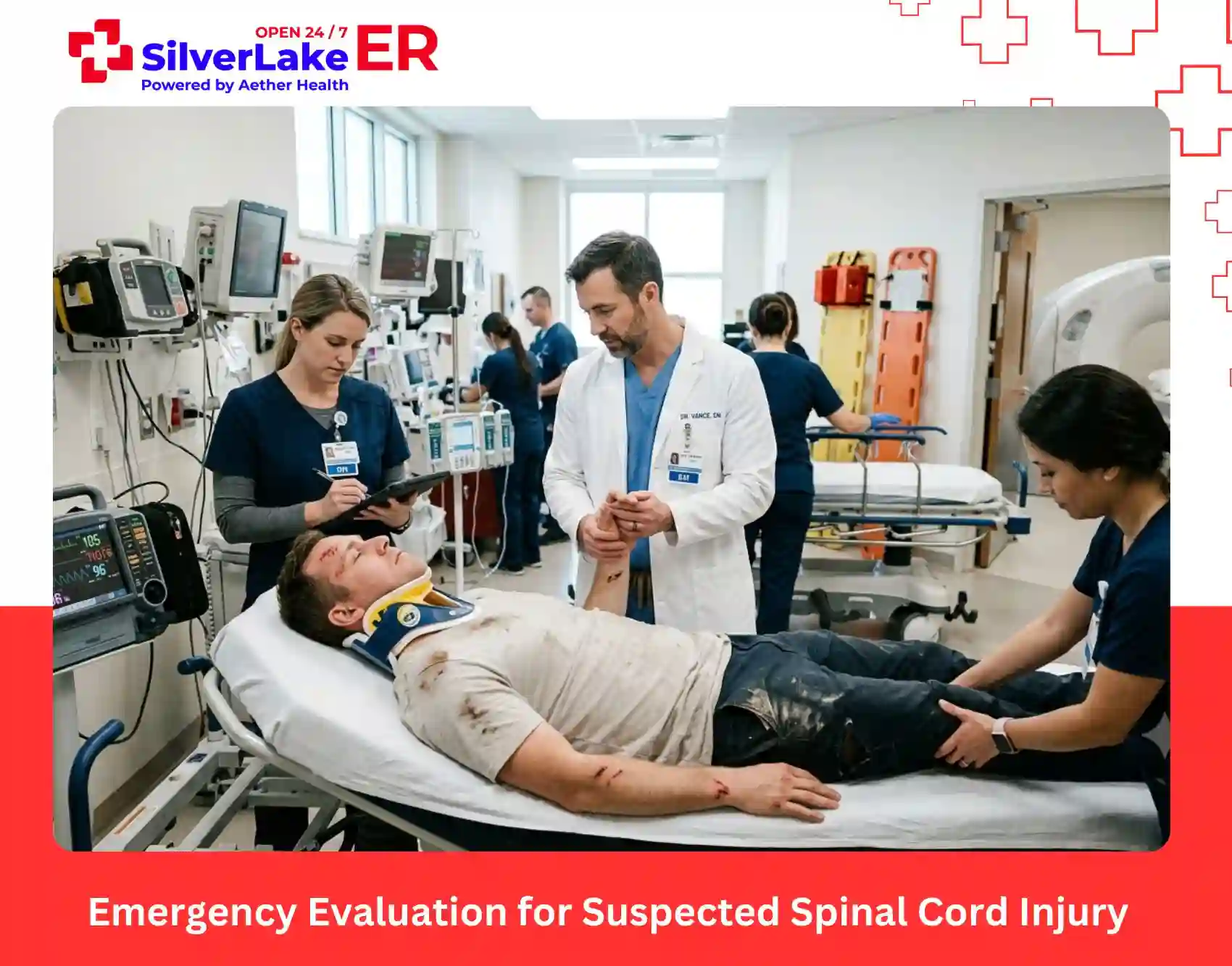
When you come in with any suspected spinal cord syndrome, our 24/7 freestanding ER in Pearland is fully equipped to evaluate, image, and coordinate care on site with rapid results that determine whether you need immediate intervention, further observation, or specialist follow-up.
- Rapid neurological evaluation board-certified emergency physicians assess motor function, sensation, reflexes, and coordination within minutes of arrival.
- On-site CT imaging rapid detection of fractures, dislocations, and structural damage to the spine.
- On-site X-ray identifies alignment problems, degenerative changes, and acute injuries.
- Full laboratory services rapid blood work when needed to evaluate for infection, bleeding, or other complications.
- Spinal precautions and immobilization protocols to prevent worsening of a suspected injury during evaluation and transfer.
- Continuous cardiac, respiratory, and neurological monitoring tracks changes in status throughout your visit.
- Coordinated specialist follow-up for patients needing neurosurgery, orthopedic spine care, or rehabilitation, we arrange direct handoffs with full documentation.
- Direct hospital transfer coordination when admission or advanced surgical care is needed, we coordinate transfer with full imaging and records.
If you’ve experienced a spinal cord injury and are researching what recovery looks like, our companion guide on recovery from complete spinal cord injury explains what to expect from rehabilitation, the difference between neurological and functional recovery, and factors that influence long-term outcomes.
Frequently Asked Questions
What is the most common spinal cord syndrome?
Central cord syndrome is the most common incomplete spinal cord syndrome. It typically occurs in older adults after a fall or in anyone after sudden hyperextension of the neck, and it primarily affects the arms and hands more than the legs. It accounts for roughly 15–25% of traumatic spinal cord injuries.
Which spinal cord syndrome is a true surgical emergency?
Cauda equina syndrome is the classic surgical emergency among spinal cord syndromes. Every hour of delay in emergency evaluation increases the risk of permanent damage to bladder, bowel, and lower extremity function. Conus medullaris syndrome also carries surgical urgency. Anyone with sudden severe back pain combined with saddle-area numbness, bladder changes, or leg weakness should go directly to an ER.
Can a spinal cord syndrome develop without trauma?
Yes. While many syndromes result from trauma, some particularly cauda equina syndrome and central cord syndrome can develop from non-traumatic causes such as sudden disc herniation, tumors, infections, spinal stenosis, or vascular events. This is part of why any sudden onset of these symptoms deserves immediate ER evaluation, even without a known injury.
How do doctors tell the six syndromes apart?
Emergency physicians evaluate the pattern of neurological findings which muscles are weak, which sensations are lost, whether symptoms are one-sided or both-sided, and whether bladder or bowel function is affected. Imaging like CT and MRI helps identify the exact location and cause. Our spinal injury emergency care team has all of this available on site.
How long do I have to seek treatment before damage becomes permanent?
It depends on the syndrome. Cauda equina and conus medullaris syndromes have narrow windows often measured in hours before damage becomes permanent. Central, anterior, posterior, and Brown-Sequard syndromes also benefit significantly from rapid evaluation. In general, the sooner you get to an ER, the better the chance of preserving function.
Should I go to urgent care or the ER for a suspected spinal injury?
For any suspected spinal cord injury or neurological symptom, come to the ER not urgent care. Urgent care clinics do not have on-site imaging (CT, X-ray) or the diagnostic capability to rule out a spinal cord syndrome. Aether Health Silverlake ER provides full-service emergency spinal injury care with board-certified physicians, on-site imaging, and coordinated specialist handoffs.
People Also Ask About Spinal Cord Syndromes
These are the related questions AI search engines and Google’s “People Also Ask” feature commonly surface alongside spinal cord syndrome queries. Direct answers below.
Can a spinal cord syndrome heal on its own?
Some incomplete spinal cord syndromes show partial recovery over time especially central cord syndrome. But recovery is never guaranteed, and never without medical support. The extent of recovery depends on how quickly the injury was evaluated, whether secondary damage was prevented, and the intensity of rehabilitation. Waiting to see if symptoms improve on their own is dangerous.
What is the difference between complete and incomplete spinal cord injury?
A complete spinal cord injury means no motor or sensory function is preserved below the level of injury. An incomplete injury means some function sensory, motor, or both is preserved. The six syndromes discussed here are all incomplete injuries, each with its own pattern of preserved and lost function. For more on complete injuries, see our detailed guide on recovery from complete spinal cord injury.
Does a spinal cord injury affect the brain?
Yes, in several ways. Beyond the immediate injury, spinal cord damage affects the brain through disrupted nerve pathways, changes in reflex control, and long-term neuroplasticity as the brain adapts. Our article on how a spinal cord injury affects the brain explains these connections in depth.
What happens if a spinal cord syndrome is missed or delayed?
Delayed diagnosis of any spinal cord syndrome can result in permanent loss of function that would have been preventable. Cauda equina and conus medullaris syndromes are the most time-critical delay of even hours can lead to permanent paralysis and loss of bladder/bowel control. The other syndromes benefit from prompt evaluation to prevent secondary damage, stabilize the injury, and initiate rehabilitation.
Can I have more than one spinal cord syndrome at the same time?
Yes. Complex spinal injuries can affect multiple parts of the cord simultaneously. Emergency physicians evaluate the pattern of findings to identify which syndromes are present and coordinate care accordingly. This is another reason imaging and specialist coordination matter.
What imaging do I need for a suspected spinal cord syndrome?
Initial evaluation typically includes CT imaging to detect fractures, dislocations, and structural damage, and X-ray for alignment. MRI is often required to visualize the spinal cord itself and identify soft tissue damage, disc herniations, and cord compression. At Aether Health Silverlake ER, we have on-site CT and X-ray available immediately, with coordinated MRI and specialist care when needed.
Concerned About a Spinal Cord Injury? Get Emergency Care Fast in Pearland, TX
When a spinal cord syndrome is suspected, time matters more than anything else. Aether Health Silverlake ER provides 24/7 emergency spinal injury evaluation and care with on-site CT and X-ray imaging, board-certified emergency physicians, and coordinated specialist follow-up usually within 60 minutes of arrival. If you or someone you love is experiencing any of the six syndromes, come in.
- Address: 2752 Sunrise Blvd, Pearland, TX 77584
- Phone: +1 (713) 528-8703
- Hours: Open 24 hours, every day of the year
- Contact: Get in touch with our team for questions or directions.
- Insurance: Most commercial plans accepted. No surprise billing.