
Short answer: some blood clots can dissolve on their own, but many cannot and the dangerous ones almost never do without medical treatment. The body has a built-in system for breaking down small clots, but when a clot forms in a deep vein, an artery, or anywhere it can interrupt blood flow to vital organs, waiting for it to resolve naturally is a gamble that can cost your life.
This guide explains how the body naturally breaks down clots, which types may resolve without intervention, which absolutely require treatment, and how to know the difference. At Aether Health – Silverlake ER in Pearland, TX, our board-certified emergency physicians diagnose and treat blood clot emergencies 24/7 because when it comes to suspected clots, time isn’t on your side.
1. The Short Answer: What You Need to Know First
Here’s the evidence-based summary every patient should understand:
- Small, superficial clots can sometimes resolve on their own through the body’s natural clot-breakdown process.
- Deep vein thrombosis (DVT) and pulmonary embolism (PE) do not reliably resolve without treatment and they’re life-threatening.
- Arterial clots (causing heart attacks and strokes) require immediate medical intervention. Waiting is not an option.
- Even clots that do dissolve naturally can leave permanent damage to the vein or surrounding tissue.
- You usually can’t tell from symptoms alone which kind of clot you have. Medical evaluation is the only reliable way to know.
Bottom line: Don’t wait to see if a suspected blood clot “goes away.” If you’re asking the question, the safest answer is to get checked.
2. How the Body Naturally Breaks Down Blood Clots
Your body has a built-in system for managing clots called fibrinolysis. Understanding how it works helps explain when it succeeds and when it fails.
When a clot forms, your blood contains an enzyme called plasmin (and its precursor, plasminogen). Plasmin’s job is to break down the fibrin mesh that holds clots together. In the body’s normal balance, every time a clot forms to seal a small injury, the fibrinolysis system gradually dissolves it once the area has healed. This process typically takes weeks to months for small clots and can be effective for minor surface clots.
The system has limits. It works best on:
- Small clots in superficial veins close to the skin
- Clots that form in response to minor injuries
- Bruises and surface bleeding sites
It struggles or fails entirely with:
- Large clots in deep veins
- Clots blocking arteries
- Clots that grow faster than the body can dissolve them
- Clots in patients with clotting disorders or on certain medications
When fibrinolysis can’t keep up or when the clot is in a dangerous location medical treatment becomes essential.
3. Types of Blood Clots and How They Differ in Resolution
Not all blood clots are the same, and they behave very differently when it comes to natural resolution.
Superficial Thrombophlebitis
A clot that forms in a vein just under the skin, often visible as a red, tender, cord-like lump. These clots are typically smaller, less dangerous, and often resolve on their own over weeks. They still need medical evaluation because they can occasionally extend into deeper veins.
Deep Vein Thrombosis (DVT)
A clot in one of the deep veins, usually in the leg. DVTs are dangerous because pieces can break loose and travel to the lungs. They rarely dissolve on their own at a meaningful rate and the longer they sit, the higher the risk of complications like pulmonary embolism and post-thrombotic syndrome.
Pulmonary Embolism (PE)
A clot that has traveled to the lungs and lodged in a pulmonary artery. PE is a medical emergency. Without treatment, large pulmonary embolisms can be fatal within hours. Small ones may eventually be broken down by the body, but waiting is dangerous there’s no reliable way to predict which PE will resolve and which will worsen.
Arterial Clots
These cause heart attacks (when a clot blocks a coronary artery) and ischemic strokes (when a clot blocks a brain artery). They do not resolve on their own in any clinically meaningful timeframe. Every minute that passes without treatment increases the damage to heart muscle or brain tissue.
Bruises and Hematomas
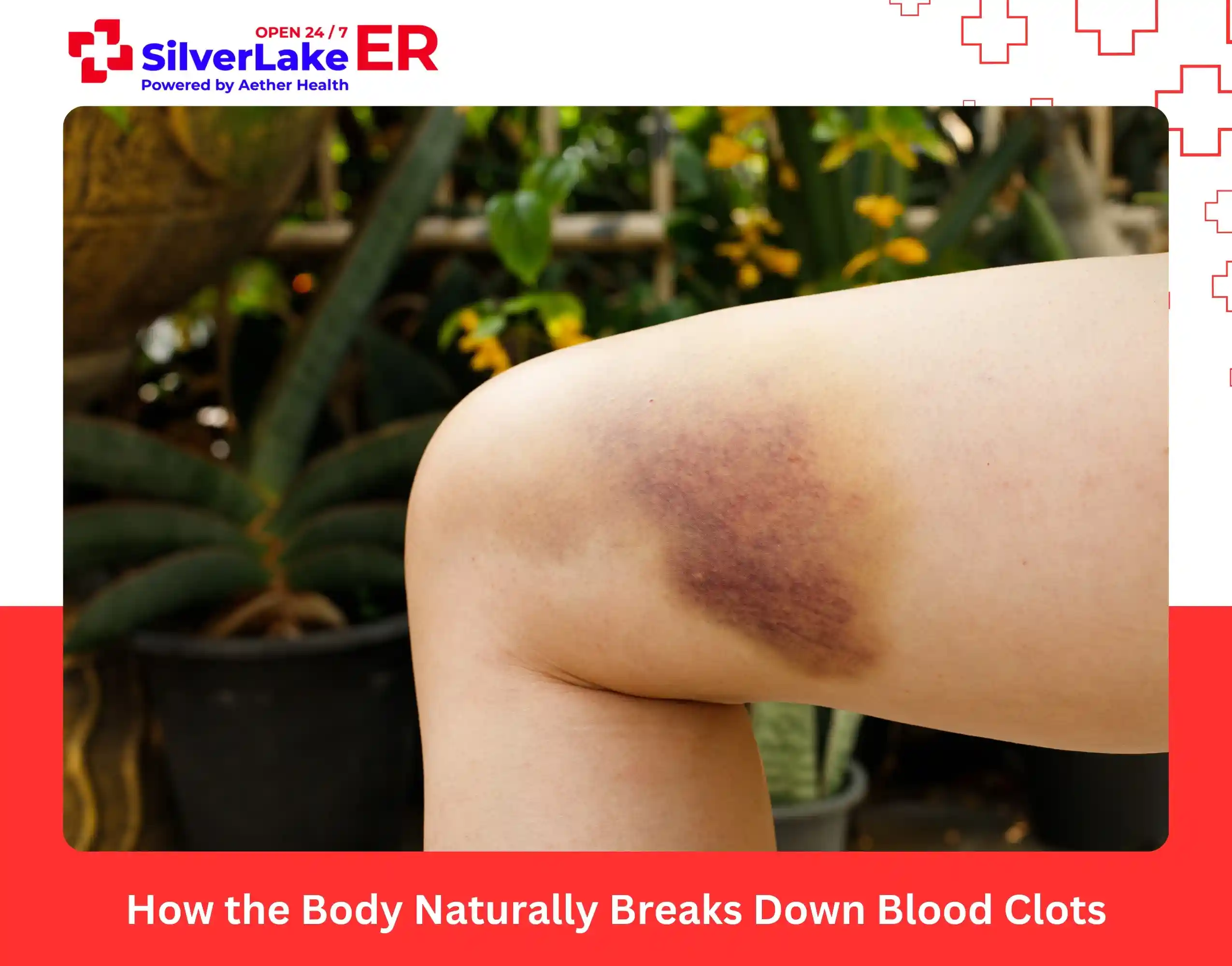
These are technically blood pooling outside of blood vessels rather than clots inside them. The body absorbs and clears them gradually typically over 1–3 weeks for small bruises and longer for larger hematomas. Most resolve without intervention, though large or deep hematomas may need drainage.
4. When Blood Clots Can Resolve Without Treatment
There are specific situations where waiting and monitoring is reasonable under medical guidance. These include:
- Small superficial thrombophlebitis (in a small vein near the skin, not extending toward deeper veins). Treatment is usually warm compresses, anti-inflammatory medications, and monitoring.
- Surface bruises and minor hematomas that aren’t growing, painful, or located near vital structures.
- Small clots formed during minor procedures where a healthcare team has already evaluated the risk.
- Some very small distal DVTs (clots in calf veins only) may be monitored rather than treated in carefully selected, low-risk patients. This decision must be made by a physician never on your own.
Even in these cases, medical evaluation is still important to make the call. The risk of misidentifying a serious clot as a minor one is too high to manage at home.
5. When Blood Clots Will NOT Disappear on Their Own
These types of clots require medical intervention. Hoping they’ll resolve on their own is a dangerous bet.
Deep Vein Thrombosis (DVT)
DVTs need anticoagulation therapy to prevent growth, prevent embolization to the lungs, and reduce long-term complications. Untreated DVTs are associated with significantly higher rates of pulmonary embolism and post-thrombotic syndrome a chronic condition causing leg pain, swelling, and ulcers.
Pulmonary Embolism (PE)
PE is a medical emergency. Treatment with anticoagulants and, in severe cases, clot-busting medications (thrombolytics) is essential. Without treatment, mortality from PE is high. With prompt treatment, survival rates improve dramatically.
Coronary Artery Clots (Heart Attack)
When a clot blocks a coronary artery, heart muscle starts dying within minutes. Emergency treatment clot-dissolving drugs, catheter-based clot removal, or stent placement is needed within hours to limit damage and save lives.
Cerebral Artery Clots (Ischemic Stroke)
Stroke caused by a brain artery clot follows a similar pattern. The treatment window for clot-busting drugs and mechanical clot removal is narrow every minute lost equals more brain tissue damaged. “Time is brain.”
Clots in Major Veins of the Abdomen, Pelvis, or Brain
Less common but extremely serious these require specialized care and aggressive treatment. Never assume any clot in these areas will resolve on its own.
6. Why Untreated Clots Are So Dangerous

When someone hopes a clot will go away on its own, they’re often unaware of the cascading complications that can develop.
Embolization
A piece of clot can break loose and travel to a more dangerous location. A clot in the leg can travel to the lungs (pulmonary embolism). A clot in the heart can travel to the brain (causing stroke). Embolization can happen at any time including while a person feels fine.
Permanent Tissue Damage
Clots block blood flow. Tissues downstream from the blockage lose their oxygen supply. The longer the blockage lasts, the more permanent the damage. This is why heart attacks and strokes are time-sensitive.
Post-Thrombotic Syndrome
After an untreated DVT, the affected leg can develop chronic pain, heaviness, swelling, skin discoloration, and ulcers sometimes lasting for years.
Recurrence
Untreated clots are more likely to recur. A person who has had one untreated DVT is at significantly higher risk for another.
Organ Failure or Death
Large pulmonary embolisms, untreated heart attacks, and major strokes can be fatal within hours. These are the worst-case outcomes and they’re not rare.
7. How Doctors Treat Blood Clots
When natural resolution isn’t reliable enough, medical treatment fills the gap. Treatment depends on the type, size, location, and timing of the clot.
Anticoagulant Medications (Blood Thinners)
The most common treatment drugs don’t break down existing clots; they stop them from growing while the body’s own fibrinolysis system gradually dissolves them. Anticoagulants also prevent new clots from forming.
Thrombolytic Therapy (Clot-Busters)
Powerful medications (As per physicians directions) dissolve clots. These are typically reserved for life-threatening situations, major pulmonary embolisms, large heart attacks, and strokes within a narrow treatment window. They carry significant bleeding risks, which is why they’re used only when the benefits clearly outweigh the risks.
Catheter-Directed Procedures
For some clots, doctors thread a thin catheter directly to the clot to deliver concentrated medication or physically remove it. This is common for severe DVT, certain pulmonary embolisms, and many strokes and heart attacks.
Surgical Interventions
In severe cases, surgery may be needed to remove a large clot or repair damaged blood vessels. Inferior vena cava (IVC) filters may also be placed to catch clots before they reach the lungs in patients who can’t take anticoagulants.
Compression and Supportive Care
Compression stockings, leg elevation, and gradual mobility are often part of the recovery plan after a DVT to reduce swelling and prevent post-thrombotic syndrome.
8. Warning Signs You Need Immediate Care
The most dangerous mistake with blood clots is waiting too long. If you have any of the following symptoms, do not assume they’ll go away.
Signs of a DVT Get Evaluated Today:
- Swelling in one leg (rarely both)
- Pain, tenderness, or cramping in the calf or thigh
- Skin that feels warm to the touch over the affected area
- Reddish or bluish discoloration of the skin
Signs of a Pulmonary Embolism Call 911:
- Sudden shortness of breath
- Sharp chest pain that worsens with deep breathing
- Coughing up blood
- Rapid heartbeat or palpitations
- Lightheadedness or fainting
Signs of an Arterial Clot Call 911:
- Chest pain or pressure (possible heart attack)
- Sudden weakness or numbness on one side of the body (possible stroke)
- Slurred speech or sudden confusion
- Sudden severe headache
- Sudden vision changes in one or both eyes
When in doubt, get evaluated. The cost of a precautionary ER visit is small. The cost of a missed clot can be enormous.
9. Emergency Blood Clot Care at Aether Health – Silverlake ER
Suspected blood clots require fast diagnosis and treatment. The longer a clot goes untreated, the higher the risk of permanent damage or death. As a full-service freestanding ER in Pearland, TX, Aether Health – Silverlake ER is equipped to diagnose and stabilize clot-related emergencies 24/7 without long waits typical of major hospital emergency departments.
Our capabilities include:
- Rapid evaluation by board-certified emergency physicians
- On-site diagnostic imaging including CT scans and ultrasound for clot detection
- Full laboratory services for rapid D-dimer testing and clotting workup
- Anticoagulant therapy and emergency stabilization
- Continuous cardiac, oxygen, and vital sign monitoring
- Emergency airway management when needed
- Direct hospital transfer coordination for cases requiring admission or specialty intervention
We also operate on a no balance billing policy for insured patients because medical emergencies shouldn’t come with billing ambushes.
Frequently Asked Questions
How long does it take for a blood clot to dissolve naturally?
It depends on the size and location. Small superficial clots may take days to weeks. Bruises typically clear in 1–3 weeks. Deep clots like DVTs, when treated, may take 3–6 months to fully resolve and many leave residual changes in the affected vein. Untreated DVTs may never fully resolve and significantly raise the risk of complications.
Can drinking water help dissolve a blood clot?
Staying well hydrated supports overall circulation and may reduce clot risk going forward, but no amount of water will dissolve an existing clot. There’s no home remedy that reliably treats a blood clot.
If I have no symptoms, can I assume a small clot has resolved?
No. Many clots including dangerous ones can be present with minimal or no symptoms. Pulmonary embolisms have been found in patients who felt only mildly tired. If you’ve been diagnosed with a clot, follow your physician’s treatment plan and follow-up imaging schedule rather than assuming it’s gone.
Can exercise dissolve blood clots?
Regular activity supports good circulation and reduces clot risk, but exercise will not dissolve an existing clot. In fact, vigorous activity after a recent DVT can sometimes dislodge the clot and cause it to travel which is why physicians give specific mobility guidelines after diagnosis.
If a clot dissolves on its own, will there be permanent damage?
Sometimes. Even small superficial clots can leave behind scarring in the affected vein. Larger clots even those that eventually resolve can damage venous valves and lead to chronic problems. This is one reason early treatment matters: the goal isn’t just to dissolve the clot but to limit lasting damage.
Where is Aether Health – Silverlake ER located?
We’re located at 2752 Sunrise Blvd, Pearland, TX 77584, open 24 hours a day, 7 days a week. Call (713) 528-8703 or walk in anytime.
Worried About a Blood Clot? Get Evaluated Today in Pearland, TX
If you have leg swelling, sudden shortness of breath, chest pain, or any other warning sign of a blood clot, don’t wait it out. Walk into Aether Health – Silverlake ER and you’ll be evaluated by a board-certified emergency physician immediately no appointment needed, no long waits.
📞 Call: (713) 528-8703
📍 Visit: 2752 Sunrise Blvd, Pearland, TX 77584
🌐 Online: sler247.com
🕒 Hours: Open 24/7, 365 days a year
Medical Disclaimer
This article is for general educational purposes only and is not a substitute for professional medical advice, diagnosis, or treatment. Never delay seeking medical evaluation for a suspected blood clot, and never change or stop a prescribed medication without speaking to your physician. If you or someone near you is experiencing a medical emergency, call 911 immediately or go to your nearest emergency room.