Choking is one of the most terrifying emergencies you can witness and one of the most time-sensitive. The brain can only survive about 4 to 6 minutes without oxygen before permanent damage begins. That means the person standing nearby not the paramedic on the way is the one who saves the life.
This guide walks you through exactly what to do if someone is choking, step by step. It covers adults, children, infants, unconscious victims, and what to do if you’re choking alone. Read this once now. You’ll respond faster when it counts. At Aether Health – Silverlake ER in Pearland, TX, our board-certified emergency physicians treat choking-related injuries 24/7 and we’ll explain in Section 8 why a post-choking ER check often matters even when the person seems fine.
1. How to Recognize Choking in the First 10 Seconds
Before you can help, you need to know what kind of choking is happening. The response is different for each.
Partial Airway Blockage (Person Can Still Cough or Speak)
Signs: forceful coughing, wheezing, raspy speech, watery eyes, panicked but able to move air.
Do not perform the Heimlich maneuver or back blows. The person’s own coughing is the most effective way to clear the airway. Stand close, stay calm, and encourage them to keep coughing. If coughing weakens or they can no longer make sound, move immediately to the full choking protocol.
Complete Airway Blockage (Person Cannot Cough, Speak, or Breathe)
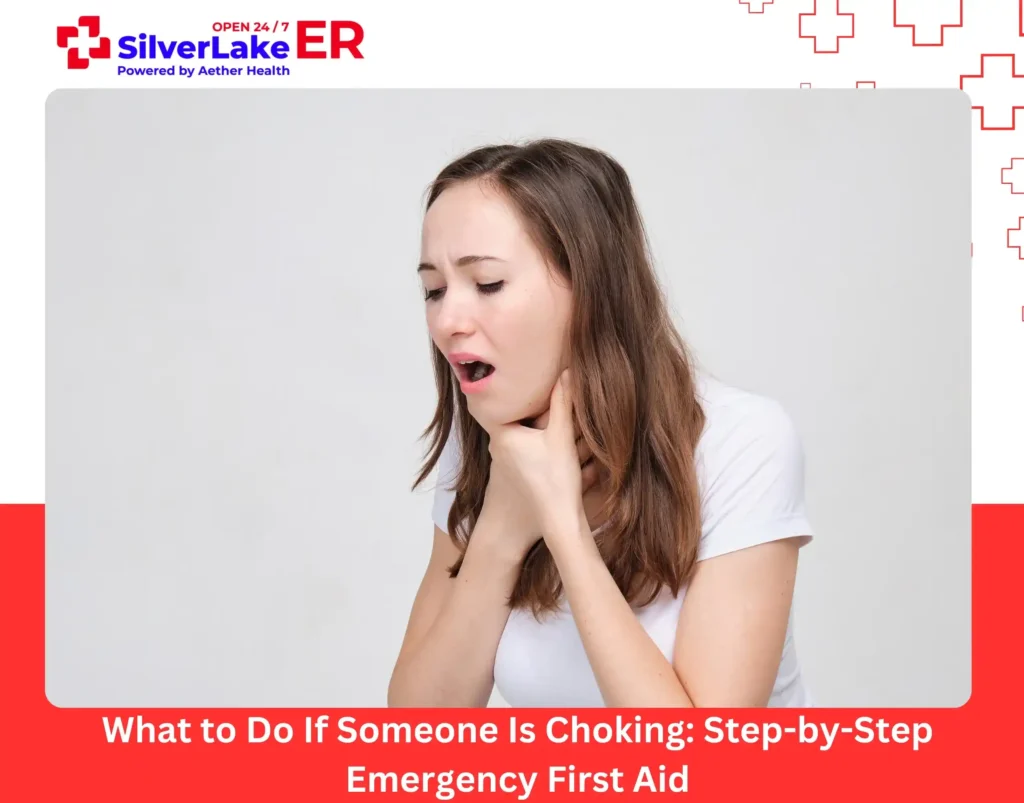
Signs: silent, hands at the throat (the universal choking sign), unable to make sound, skin turning blue or gray, panicked expression, eventually loss of consciousness.
This is an immediate emergency. Begin the first aid steps in Section 2 right now.
Quick rule: If they’re making noise, they’re moving air to encourage coughing. If they’re silent and clutching their throat, act immediately.
2. First Aid for a Choking Adult or Child Over 1 Year
For anyone older than 1 year who has a complete airway blockage and is still conscious, use this protocol. Speed matters more than perfection.
Step 1: Ask and Confirm
Quickly ask: “Are you choking? Can I help?” If they can’t answer, can’t cough, and can’t breathe begin immediately.
Step 2: Call for Help
Shout to someone nearby to call 911. If you’re alone with the person, start first aid immediately don’t waste the seconds it takes to find a phone yourself.
Step 3: Give 5 Back Blows
Stand to the side and slightly behind the person. Lean them forward at the waist so their head is lower than their chest. With the heel of your hand, deliver 5 firm blows between the shoulder blades.
Step 4: Give 5 Abdominal Thrusts (Heimlich Maneuver)
Stand behind the person. Then:
- Wrap your arms around their waist.
- Make a fist with one hand. Place the thumb side just above the belly button, well below the breastbone.
- Grasp your fist with your other hand.
- Pull sharply inward and upward like trying to lift them slightly off the ground.
- Deliver 5 quick, separate thrusts.
Step 5: Alternate Until the Object Comes Out
Continue alternating 5 back blows and 5 abdominal thrusts until the object is expelled, the person can breathe or cough on their own, or they lose consciousness. If they go unconscious, see Section 4.
3. First Aid for a Choking Infant (Under 1 Year)
Never perform abdominal thrusts on an infant. Their bodies are too small and the force can cause serious internal injury. The protocol for infants is completely different.
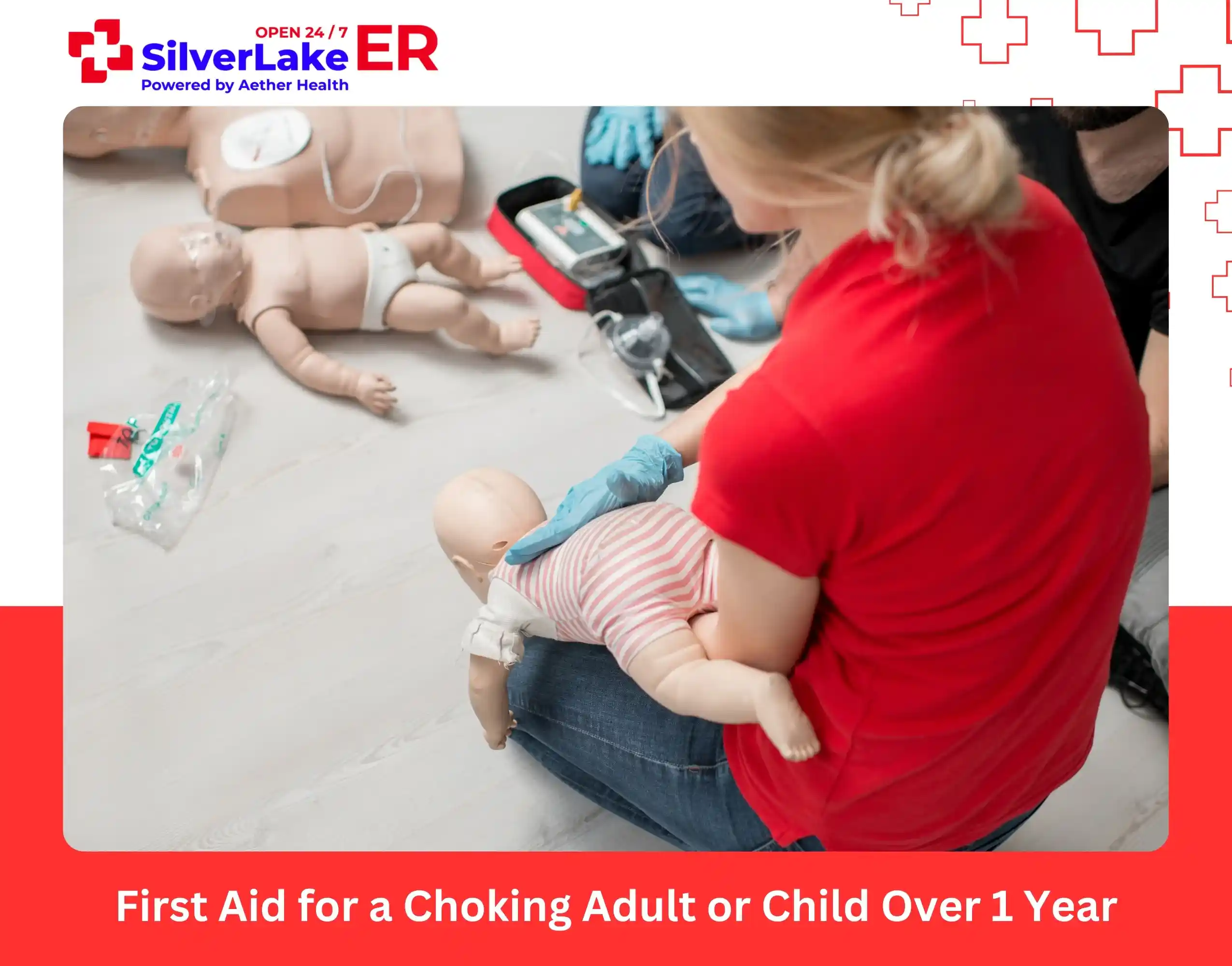
Step 1: Position the Infant
Sit down. Lay the infant face-down along your forearm, with their head lower than their chest. Support their head and jaw with your hand. Rest your forearm on your thigh for stability.
Step 2: Give 5 Back Blows
Using the heel of your other hand, deliver 5 firm but controlled blows between the shoulder blades. Use less force than you would on an adult you’re trying to dislodge, not injure.
Step 3: Turn the Infant Over
Carefully turn the infant onto their back, still supporting the head, keeping the head lower than the chest.
Step 4: Give 5 Chest Thrusts
Place two fingers on the breastbone, just below the nipple line. Press down quickly 5 times, about 1.5 inches deep. These are firmer and more rapid than CPR compressions.
Step 5: Alternate Until Cleared or Unconscious
Continue alternating 5 back blows and 5 chest thrusts. Check inside the mouth between rounds but only remove an object if you can clearly see it. Never sweep blindly with your finger; you can push the object deeper.
Critical: Call 911 immediately for any choking infant even if the object comes out and they appear fine. Infants need medical evaluation after a choking episode.
4. First Aid If the Person Becomes Unconscious
If the person collapses during a choking episode, switch protocols immediately. This is now a CPR situation with airway management.
Step 1: Lower Them Safely to the Ground
Lay them on their back on a firm, flat surface.
Step 2: Call 911 If Not Already Done
If someone else is present, tell them to call now. If you’re alone, call 911 yourself and put the phone on speaker before starting CPR.
Step 3: Begin CPR
Start chest compressions immediately 30 compressions, about 2 inches deep for adults, at 100–120 per minute. Push hard and fast in the center of the chest.
Step 4: Check the Mouth Before Each Breath
After every 30 compressions, open the mouth and look inside. If you can clearly see the object, remove it with your fingers. If you don’t see it, do not blindly sweep give 2 rescue breaths and continue CPR.
Step 5: Don’t Stop Until Help Arrives
Continue CPR until paramedics take over or the person starts breathing on their own.
5. What to Do If You’re Choking and Alone
If you’re choking and no one is around, self-rescue is possible. Do not panic that wastes oxygen and time.
Self-Heimlich on a Counter or Chair Back
- Make a fist and place it just above your belly button.
- Grasp your fist with your other hand.
- Find a firm, fixed object the back of a sturdy chair, a counter edge, a railing.
- Thrust your upper abdomen against the edge hard and fast, repeating until the object is expelled.
Call for Help Even After Self-Rescue
If you manage to clear the airway alone, still call 911 or get to an ER. The forces involved can cause internal injuries and if you can’t clear it, you’ll need help reaching you fast.
6. Special Situations: Pregnant Women, Larger Bodies, Wheelchair Users
Pregnant Women or Anyone With a Large Abdomen
Standard abdominal thrusts may not be safe or effective. Use chest thrusts instead:
- Stand behind the person.
- Place your fist in the center of the breastbone not over the lower ribs.
- Grasp your fist with the other hand and pull straight back in firm thrusts.
- Continue until the object is dislodged or they lose consciousness.
Wheelchair Users or Anyone Who Can’t Stand
Position yourself behind the chair if possible. Apply abdominal thrusts the same way you would for a standing person wrapping arms around the waist, fist above the navel, thrusting inward and upward. If you can’t reach from behind, kneel in front and use chest thrusts.
Very Small Children Over 1 Year
Use less force than for an adult. Kneel behind them so you can comfortably reach around their waist, and use the same protocol back blows and abdominal thrusts but scale the force down.
7. What NOT to Do in a Choking Emergency
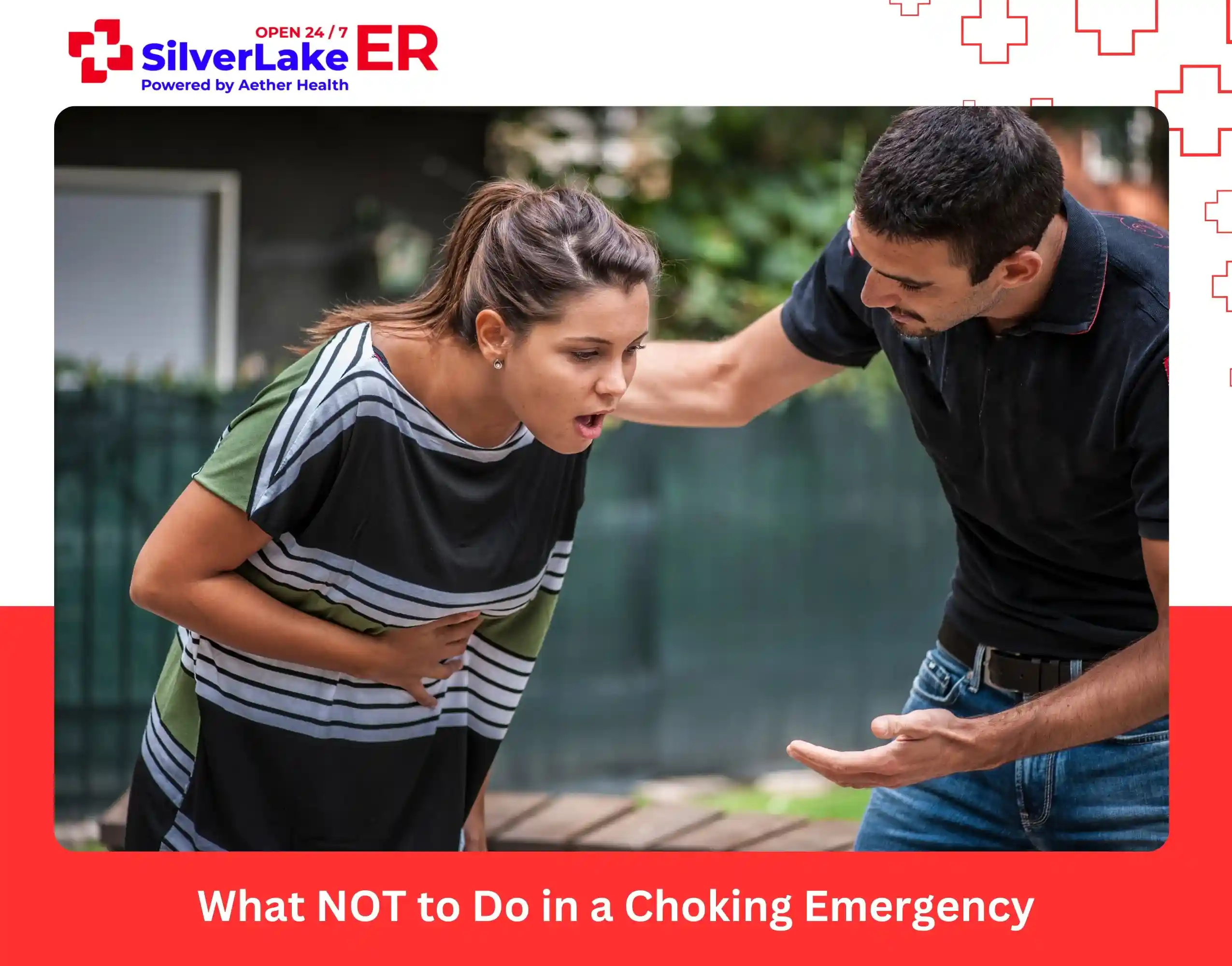
Some instincts are wrong. These can make a choking emergency worse.
- Do not perform a blind finger sweep. Sticking a finger into the throat when you can’t see the object risks pushing it deeper and further blocking the airway. Only remove an object you can clearly see.
- Do not give water or food to wash it down. If the airway is completely blocked, liquid won’t go down. If it’s partially blocked, water can make things worse.
- Do not slap the back of someone who is sitting upright. Without the head positioned lower than the chest, back blows can drive the object deeper.
- Do not perform abdominal thrusts on an infant. Their internal organs are too small and fragile. Use back blows and chest thrusts only.
- Do not stop too soon. If the person is unconscious, keep doing CPR until paramedics arrive even if it’s been several minutes.
- Do not skip the ER visit afterward. Even successful first aid can cause internal injuries that need evaluation.
8. After the Episode: When You Still Need an ER Visit
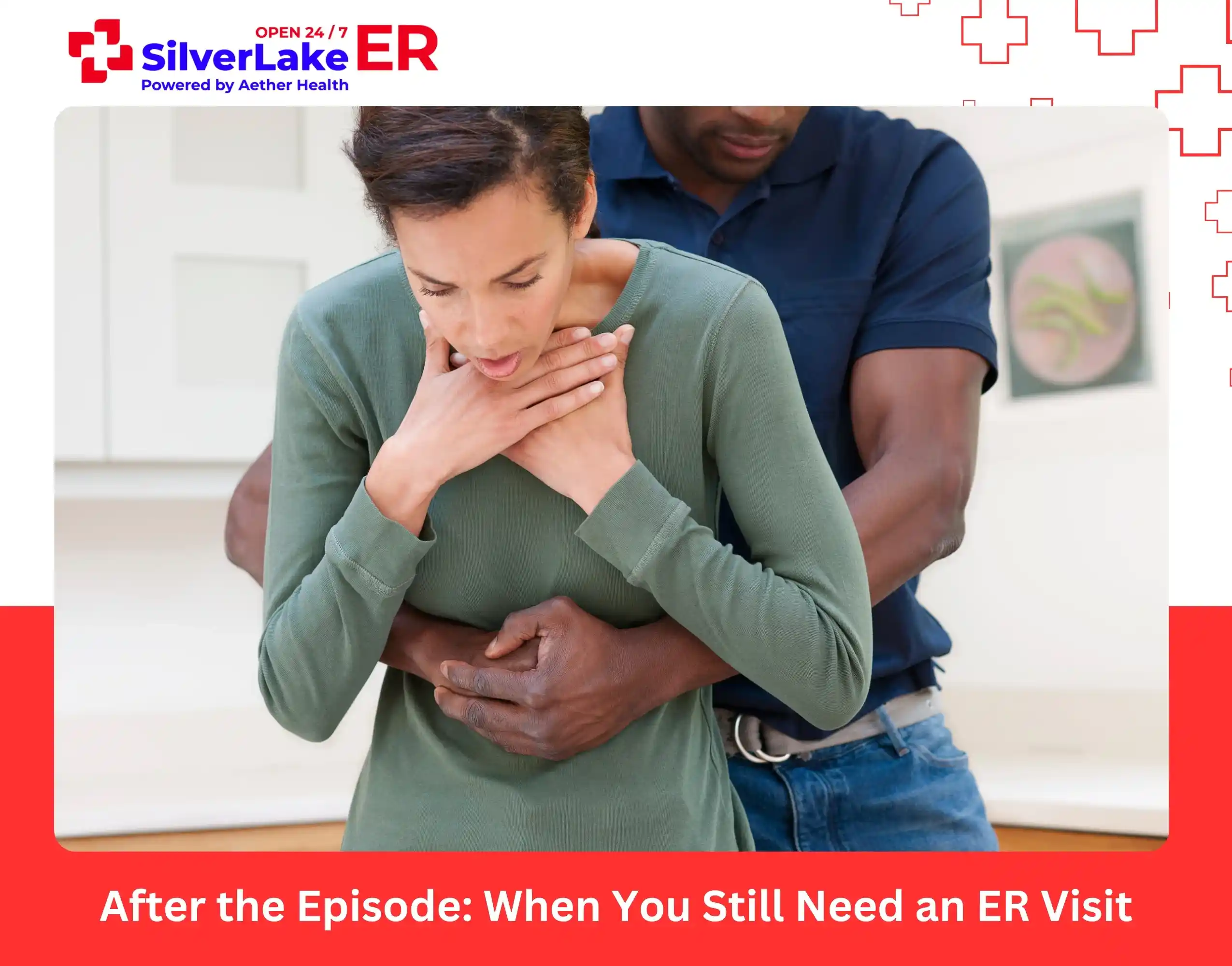
Many people assume that once the object comes out and the person is breathing normally, the emergency is over. Often it’s not. A choking episode and the force required to clear it can leave behind problems that need medical evaluation.
Go to an ER after a choking episode if any of the following apply:
- Abdominal thrusts or chest thrusts were performed (these can cause rib fractures, internal bleeding, or organ injury)
- The person lost consciousness, even briefly
- The person continues to cough, wheeze, or have trouble breathing
- There’s persistent chest or abdominal pain
- The person feels like something is still stuck in their throat
- Any voice change, drooling, or difficulty swallowing remains
- The person who choked is an infant or young child always evaluate after a choking event
- The person who choked is elderly or has a chronic medical condition
When in doubt, get checked. Aspirated food or foreign objects can cause pneumonia days later if a piece is still in the airway. A quick ER evaluation rules that out.
9. Emergency Choking Care at Aether Health – Silverlake ER
Choking emergencies and their aftereffects are time-sensitive. Even when the airway is cleared, the force used during first aid can cause injuries that aren’t visible from the outside. As a full-service freestanding ER in Pearland, TX, Aether Health – Silverlake ER is equipped to evaluate and treat choking-related emergencies 24/7, without the long waits typical of major hospital ERs.
Our capabilities include:
- Rapid airway assessment by board-certified emergency physicians
- On-site diagnostic imaging, including X-rays and CT scans
- Full laboratory services for rapid diagnostic testing
- Evaluation for rib fractures, internal injury, and aspiration pneumonia
- Emergency airway management and oxygen therapy
- Pediatric and adult emergency care under one roof
- Continuous cardiac and respiratory monitoring
- Direct hospital transfer coordination when admission is needed
We also operate on a no balance billing policy for insured patients because medical emergencies shouldn’t come with billing ambushes.
Frequently Asked Questions
How long can someone survive without oxygen during choking?
Brain damage can begin within 4 to 6 minutes of oxygen deprivation. Permanent damage is likely after 6–10 minutes, and death typically follows within 10 minutes. This is why immediate action matters more than waiting for paramedics.
Should I always call 911 for a choking incident?
Yes. Call 911 the moment you confirm someone has a complete airway blockage even if you’re confident in your first aid. If the airway clears quickly and the person is fine, you can update dispatch, but never delay the call.
Can the Heimlich maneuver cause injury?
Yes, even when done correctly. Common injuries include rib fractures, bruising, and occasionally internal organ damage. This is normal and far less serious than choking but it’s why anyone who received abdominal thrusts should be evaluated by an ER physician afterward.
What’s the most common cause of choking in adults?
Food is the leading cause. Common culprits include large pieces of meat, bread, raw vegetables, hot dogs, and candy. Risk increases with rushed eating, talking while chewing, alcohol consumption, and dental problems that affect chewing.
What’s the most common cause of choking in children?
Round, firm, smooth foods and small objects. Hot dogs, grapes, nuts, popcorn, hard candy, and small toy parts cause the majority of pediatric choking cases. Always cut round foods into small, irregular pieces for young children, and keep small objects out of reach.
Where is Aether Health – Silverlake ER located?
We’re located at 2752 Sunrise Blvd, Pearland, TX 77584, open 24 hours a day, 7 days a week. Call (713) 528-8703 or walk in anytime.
Choking Emergency? Get Checked Out in Pearland, TX
If you or someone you love just experienced a choking episode especially one requiring back blows, abdominal thrusts, or CPR don’t skip the follow-up. Walk into Aether Health – Silverlake ER and you’ll be evaluated by a board-certified emergency physician immediately. No appointment, no long waits.
📞 Call: (713) 528-8703
📍 Visit: 2752 Sunrise Blvd, Pearland, TX 77584
🌐 Online: sler247.com
🕒 Hours: Open 24/7, 365 days a year
Medical Disclaimer
This article is for general educational purposes only and is not a substitute for hands-on first aid training or professional medical advice. The American Red Cross and American Heart Association both offer certified first aid and CPR courses strongly recommended for anyone responsible for the care of children, elderly family members, or anyone with health conditions. In any choking emergency, call 911 immediately or go to your nearest emergency room.