When someone has a cardiac arrest, the heart suddenly stops pumping blood effectively. Within seconds, the brain is starved of oxygen and the person loses consciousness and collapses. Without immediate intervention — CPR and defibrillation — survival is highly unlikely past the first 10 minutes. Cardiac arrest affects more than 350,000 people outside of hospitals in the United States every year, and survival depends almost entirely on how fast bystanders act.
This guide walks through exactly what happens during a cardiac arrest, second by second and minute by minute — what’s happening inside the body, what symptoms appear, what saves lives, and what to expect at an emergency room afterward. At Aether Health – Silverlake ER in Pearland, TX, our board-certified emergency physicians treat cardiac emergencies 24/7. Understanding what’s happening can help you recognize an emergency and act faster than you might otherwise.
1. The Short Answer: What Cardiac Arrest Actually Is
Here’s what every patient and family member should understand about cardiac arrest:
- Cardiac arrest is an electrical failure of the heart, not a circulation problem like a heart attack.
- The heart’s normal rhythm collapses into a chaotic pattern (usually ventricular fibrillation), and the heart can no longer pump blood.
- Within seconds, the brain loses oxygen, the person becomes unresponsive, and breathing stops or becomes abnormal. Loss of consciousness is sudden and complete.
- Without CPR and defibrillation, survival rates drop by about 10% for every minute that passes.
- Cardiac arrest is reversible if treated fast. Immediate bystander CPR can double or triple survival chances.
Key distinction: Cardiac arrest and heart attack are different events. A heart attack is a blocked artery; cardiac arrest is an electrical collapse. A heart attack can trigger cardiac arrest, but they aren’t the same thing.
2. The First 10 Seconds: Electrical Failure
The heart runs on electricity. A small cluster of cells called the sinoatrial (SA) node generates rhythmic electrical signals that tell the heart muscle when to contract. In a healthy heart, this happens 60–100 times per minute, in a coordinated wave.
When cardiac arrest begins, that electrical system fails. The most common cause is a chaotic rhythm called ventricular fibrillation — the lower chambers of the heart receive disorganized electrical signals and start to quiver instead of contracting. Other cardiac arrest rhythms include ventricular tachycardia (an extremely fast, ineffective heartbeat), pulseless electrical activity (electrical signals without an effective heartbeat), and asystole (no electrical activity at all).
In any of these scenarios, the heart stops pumping blood. Even though electrical activity may be happening, no oxygenated blood is reaching the brain or other organs. The clock starts the moment that pumping action stops.
3. Seconds 10–60: Loss of Consciousness and Collapse
Within 6 to 12 seconds of effective cardiac arrest, the brain runs out of oxygen-rich blood and consciousness fails. What this looks like from the outside:
- The person suddenly collapses — often mid-sentence, mid-step, or mid-activity
- They become unresponsive when shaken or called by name
- Their eyes may roll back or remain open and unfocused
- Breathing stops, or becomes abnormal — gasping, gurgling, or snoring-like
- Skin color may turn pale, gray, or bluish, especially around the lips and fingertips
- There is no detectable pulse
This last point is important: the gasping that sometimes follows cardiac arrest — called agonal breathing — is often mistaken for the person still breathing. It’s a reflex, not effective breathing. If the person is unresponsive and only gasping irregularly, treat it as cardiac arrest and start CPR.
Common mistake: People often wait to see if the collapsed person “wakes up” or believe gasping means they’re still breathing. By the time it becomes obvious that something is seriously wrong, critical seconds have been lost. When in doubt, start CPR.
4. Minutes 1–4: The Critical Survival Window
This is the window where outcomes are largely determined. Brain cells start to die from oxygen deprivation within 4 to 6 minutes. Other organs follow not long after.
What’s Happening Inside the Body
- Brain cells begin to suffer immediate energy failure within seconds, but cellular damage takes minutes to become irreversible
- Oxygen reserves in tissues are quickly depleted
- Heart muscle itself begins to weaken from lack of blood flow
- Acidosis (acid buildup) develops in blood and tissues
- Other organs — kidneys, liver, intestines — begin to show stress
What Saves a Life in This Window
Two interventions matter most:
- Immediate, hard, fast CPR — Compressions of 2 inches deep at 100–120 per minute keep some oxygenated blood flowing to the brain and vital organs.
- Defibrillation as soon as possible — A controlled electrical shock can restart a normal rhythm if the arrest is caused by ventricular fibrillation or pulseless ventricular tachycardia. Public AEDs are designed for bystanders and provide voice prompts.
For every minute that passes without CPR or defibrillation, the chance of survival drops by approximately 10%. With prompt bystander CPR and defibrillation, survival rates can exceed 40%. Without bystander action, they fall below 10%.
5. Minutes 4–10: Permanent Damage Threshold
Past about 4 minutes of untreated cardiac arrest, the risk of permanent brain damage rises sharply. By 10 minutes without intervention, survival without significant brain injury becomes very unlikely.
This is why the chain of survival emphasizes speed at every step. Bystander CPR — even if imperfect — significantly slows the brain damage clock. It buys time for trained responders, an AED, or an ambulance to arrive.
Without any intervention, most people in cardiac arrest will not recover. With prompt CPR and defibrillation, many will. The difference is measured not in hours or even minutes — but in seconds of decisive action by whoever is closest.
6. What Cardiac Arrest Feels Like (When Symptoms Appear)
Sudden cardiac arrest is often described as exactly that — sudden, with no warning. But research shows that more than half of cardiac arrest victims experience warning symptoms in the hours, days, or weeks leading up to the event. These are easy to dismiss but matter a great deal.
Symptoms in the Moment of Arrest
Most people who survive a cardiac arrest don’t remember anything about the event itself. The loss of consciousness is too fast for conscious recall. The last things some survivors remember include:
- Sudden dizziness or feeling faint
- Chest tightness or pressure
- A rapid or pounding heartbeat
- Sudden shortness of breath
- A sense of impending doom
- Then nothing — they wake up in a hospital or surrounded by emergency responders
Warning Symptoms Hours or Days Before
- Chest pain or pressure, especially with exertion
- Unexplained shortness of breath
- Heart palpitations or a racing heartbeat
- Sudden severe dizziness or near-fainting episodes
- Unexplained extreme fatigue
- Nausea paired with any of the above
If you have any of these warning signs — especially with a history of heart disease or family history of sudden cardiac death — don’t wait. Get to an ER. Aether Health – Silverlake ER offers immediate evaluation, no appointment, 24/7.
7. The Chain of Survival: What Actually Saves Lives
The American Heart Association calls the sequence of life-saving actions the “Chain of Survival.” Each link matters, and the chain is only as strong as its weakest link.
Link 1: Immediate Recognition and Call for Help
Recognizing cardiac arrest fast — unresponsive, not breathing normally — and calling 911 starts the chain. Delays of even a minute or two significantly reduce survival odds.
Link 2: Early Bystander CPR
Starting compressions immediately — hard, fast, in the center of the chest — keeps oxygenated blood flowing to the brain. Hands-only CPR (no mouth-to-mouth) is effective and easier for untrained bystanders to perform confidently.
Link 3: Rapid Defibrillation
Automated External Defibrillators (AEDs) are designed for bystanders and provide step-by-step voice instructions. Many public places — gyms, schools, airports, malls — have them. The earlier defibrillation happens, the higher the survival rate.
Link 4: Advanced Life Support by EMS
Paramedics deliver advanced cardiac care en route to the hospital — medications, intubation, advanced rhythm management — that bystanders cannot.
Link 5: Post-Cardiac Arrest Hospital Care
Once stabilized, patients receive specialized care: cardiac catheterization to find blocked arteries, targeted temperature management to protect the brain, intensive monitoring, and treatment of the underlying cause of the arrest.
8. What Happens at the ER After Cardiac Arrest
If you arrive at an ER following a cardiac arrest, here’s what to expect during the immediate workup:
- Rapid assessment and stabilization — Continuous monitoring of heart rhythm, blood pressure, oxygen saturation, and breathing.
- EKG — To identify the cause of arrest and look for heart attack patterns.
- Blood tests — Cardiac enzyme levels (troponin) and metabolic panels to assess heart damage and other organ stress.
- Imaging — Chest X-ray and sometimes CT to identify complications or causes.
- Targeted temperature management — For survivors who remain unconscious, cooling the body to 32–36°C for 24 hours improves neurological outcomes.
- Coronary angiogram — When a heart attack is suspected, urgent cardiac catheterization can identify and reopen blocked arteries.
- Admission to ICU — Most cardiac arrest survivors require intensive monitoring and care for several days after the event.
9. Recovery and Long-Term Outlook
Cardiac arrest survivors face a recovery journey that depends heavily on how quickly they were treated, the underlying cause, and the quality of post-arrest care.
Short-Term Recovery (Days to Weeks)
- Most survivors spend at least several days in the ICU
- Many experience confusion, memory gaps, or fatigue in the first weeks
- The underlying cause must be identified and treated — sometimes with surgery, medications, or an implantable cardioverter-defibrillator (ICD)
- Cardiac rehabilitation often begins during this period
Long-Term Recovery (Months to Years)
- Some survivors experience persistent cognitive effects, especially short-term memory and concentration changes
- Anxiety, depression, and PTSD are common after cardiac arrest and benefit from professional support
- Lifestyle changes — diet, exercise, smoking cessation, stress management — significantly affect long-term outcomes
- Many cardiac arrest survivors return to full or near-full activity with proper rehabilitation
- ICDs are often recommended for survivors at high risk of recurrence
The most important predictor of recovery quality is how quickly CPR and defibrillation were started. Survivors who received prompt bystander CPR generally have far better neurological outcomes than those who waited for EMS.
10. Emergency Cardiac Care at Aether Health – Silverlake ER
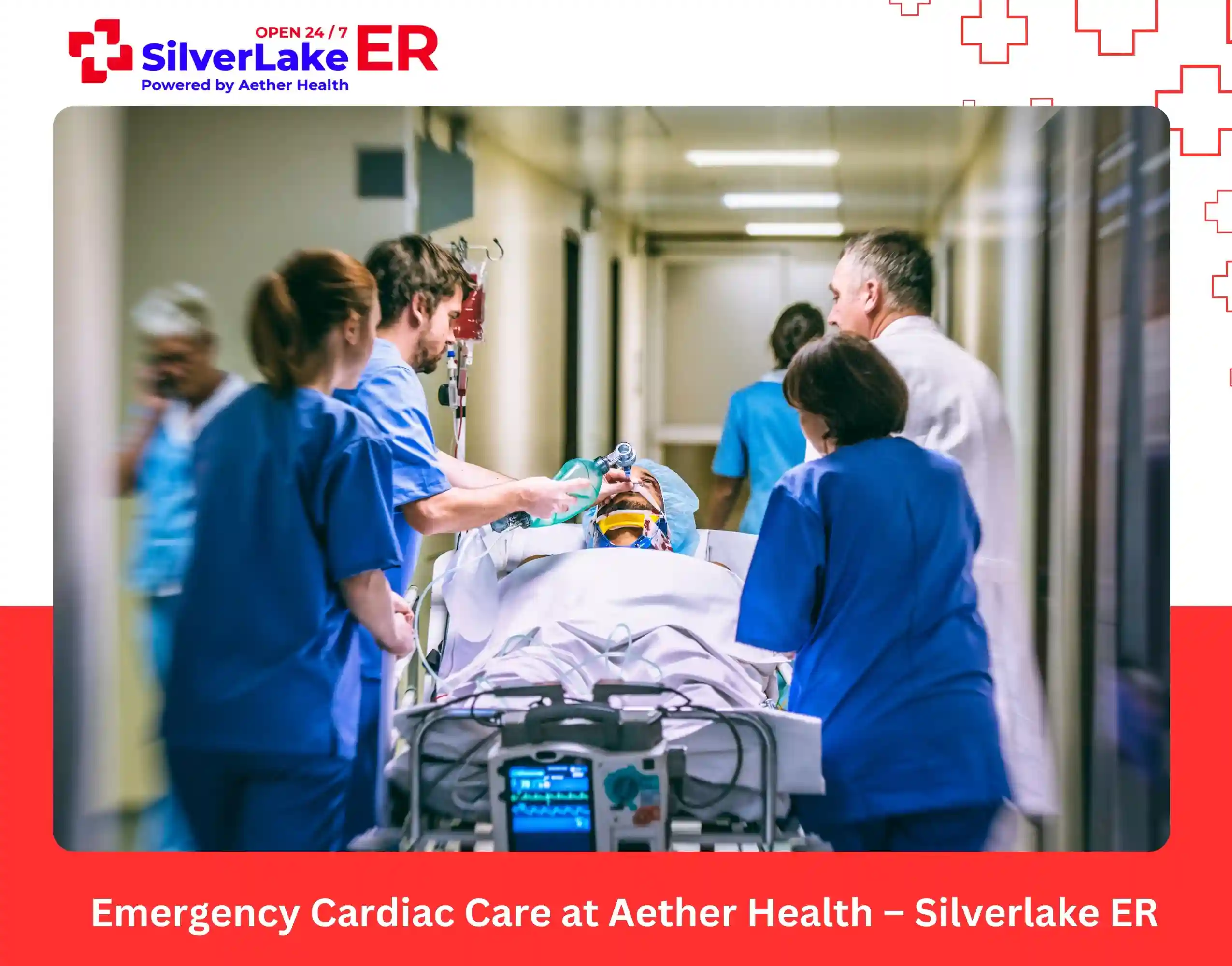
Cardiac arrest is one of the most time-critical emergencies in medicine — but cardiac warning signs, suspected heart attacks, and other cardiovascular emergencies are equally urgent. Long ER waits at major hospitals can mean dangerous delays. As a full-service freestanding ER in Pearland, TX, Aether Health – Silverlake ER is equipped to deliver hospital-level cardiac emergency care 24/7 — without the long waits typical of major hospital emergency departments.
Our cardiac emergency capabilities include:
- Rapid evaluation by board-certified emergency physicians
- Advanced Cardiac Life Support (ACLS) protocols
- On-site EKG and continuous cardiac monitoring
- Defibrillation and emergency airway management
- On-site laboratory for rapid cardiac enzyme testing
- Diagnostic imaging including CT scans and chest X-rays
- Stabilization and direct hospital transfer coordination for advanced cardiac care
We also operate on a no balance billing policy for insured patients — because medical emergencies shouldn’t come with billing ambushes.
Frequently Asked Questions
Can you feel cardiac arrest happening?
Most people lose consciousness within 6 to 12 seconds and don’t remember the event. Some survivors recall brief dizziness, chest tightness, or a pounding heart in the moments before — but loss of awareness is rapid and complete. This is different from a heart attack, where pain and other symptoms can persist while the person is fully conscious.
Can cardiac arrest happen during sleep?
Yes. Sudden cardiac arrest can occur at any time, including during sleep. Some people are found unresponsive in the morning with no evidence of when the event started, which is why nocturnal cardiac arrests have lower survival rates — there’s typically no bystander to witness the event.
Does cardiac arrest always mean death?
No. Cardiac arrest is reversible if treated quickly enough. With immediate bystander CPR and defibrillation, survival rates can exceed 40%. The earlier the response, the better the chance of full recovery. Cardiac arrest only becomes “sudden cardiac death” when treatment fails or doesn’t happen in time.
What’s the difference between cardiac arrest and a heart attack?
A heart attack is a circulation problem — a clot or blockage stops blood flow to part of the heart muscle. The person is usually still conscious. Cardiac arrest is an electrical problem — the heart’s rhythm collapses and it stops pumping. The person loses consciousness almost immediately. A heart attack can cause cardiac arrest, but they’re distinct medical events with different responses.
How long can the brain survive without oxygen during cardiac arrest?
Brain cells begin to die within 4 to 6 minutes of complete oxygen deprivation. CPR keeps some oxygenated blood flowing and can extend survivability significantly. Without any intervention, permanent brain damage is likely after 6 minutes and irreversible damage typically by 10 minutes.
Where is Aether Health – Silverlake ER located?
We’re located at 2752 Sunrise Blvd, Pearland, TX 77584, open 24 hours a day, 7 days a week. Call (713) 528-8703 or walk in anytime.
Cardiac Warning Signs? Get Evaluated Immediately in Pearland, TX
If you’re experiencing chest pain, shortness of breath, racing heartbeat, or any other warning sign of a cardiac event — don’t wait. Early evaluation can prevent cardiac arrest before it happens. Walk into Aether Health – Silverlake ER and you’ll be evaluated by a board-certified emergency physician immediately, with no appointment and no long waits.
📞 Call: (713) 528-8703
📍 Visit: 2752 Sunrise Blvd, Pearland, TX 77584
🌐 Online: sler247.com
🕒 Hours: Open 24/7, 365 days a year